Showing posts with label Parker. Show all posts

Saturday, April 11, 2015

Stoddard Benham Colby and Family Lines

Stoddard Benham Colby was born February 3 1816 Derby, Vermont and passed on September 21 1867 in Haverhill, New Hampshire
                                                              Line to Anthony Colby

ANTHONY COLBY (bp.1605 - 1660) of Horbling, 
Boston, Ipswich, Salisbury and Amesbury m. Susanna 
Unknown (d. 1689)
|
SAMUEL COLBY (abt 1638 - 1715/6) of Amesbury m. 
Elizabeth Sargeant
|
SAMUEL COLBY (b. 1671 - bef. 1746) of Amesbury m. 
Dorothy Ambrose
|
ENS. ENOCH COLBY (1702 - 1780) of Hampton Falls 
and Chester m. Abigail Sanborn
|
ENOCH COLBY (bp. 1728 - 1778) of Candia m. Abigail 
Blaisdell
|
SAMUEL COLBY (1766 - 1834) of Thornton and Derby m. 
Ruth French
|
CAPT. NEHEMIAH COLBY (1785 - 1862) of Derby m. 
Melinda Larrabee (1790 - 1842)
|
HON. STODDARD BENHAM COLBY (1816 - 1867) of 
Derby and Montpelier m. Harriet Elizabeth Proctor
|
LAURA MELINDA COLBY (1844 - 1921) m. 
Brig. Gen. Asa Bacon Carey

Stoddard B. Colby read law at Lyndon, Vt; began practice at Derby; represented it in the Legislature of Vermont; removed to Montpelier, Vt, and there remained until 1864; was State's Attorney for Washington Co. in 1851 and 1852; became Register of the U. S. Treasury in Aug. 1864. He married, 1. Harriet Elisabeth Proctor, d. of the Hon. Jabez Proctor of Proctorsville, Vt, Feb. 11, 1840. 2. Ellen Cornelia Hunt, dau. of Caleb Hunt of Haverhill, July 
12, 1855. (From Sketches of Alumni of Dartmouth College)

From Hon. Thomas Parker Redfield in "Biography of the Bar of Orleans County, Vermont" edited by Frederick W. Baldwin S B Colby was the second son of Hon. Nehemiah Colby was fitted for college in the law office of the late Isaac F. Redfield, which stood near his father's store in Derby Center. Mr. Colby was an apt and ready scholar, and Judge Redfield then fresh from college, gave him a thorough training, especially in the Greek and Latin languages, in which his young pupil had special aptitude. He entered Dartmouth College in the fall of 1832, and graduated with high honor in 1836. He studied law in the office of the late Senator Upham in Montpelier, and was admitted to the bar of Orleans county at the December term, 1838, and at once commenced practice at Derby, where he remained until 1846, representing the town of Derby in the legislature in 1841.


In 1846 he removed to Montpelier and formed a copartnership with the late Lucius B. Peck, under the firm name of Peck & Colby, and so continued until 1863, when Mr. Colby was made register of the treasury and removed to Washington. He held that office until his death. Mr. Colby was a ripe scholar, a facile and ready speaker, and from the first his manner at the bar was elegant, and his language choice and beautiful. He had a voice of peculiar compass and melody. He at once took high rank as a brilliant and accomplished advocate. He possessed a lively and vigorous imagination, and invested ideas and incidents with such charming beauty that a court or jury became insensibly and irresistibly enlisted and absorbed in the investiture with which he clothed a case.

Lucius B Peck 
                                                                     
This was no studied ornamentation, but the natural outpouring from that rich treasury which was entirely his own, and inexhaustibly full. He never essayed the emotional, and never addressed the passions of men, but he charmed them with the beautiful, and disgusted them with what was degrading and hateful, thereby enlisting their affection for the one, and arousing their contempt for the other, and by that he made sure their judgment. As a brilliant advocate he had no peer among us, and the profession suffered an irreparable loss when he was transferred to the service of the government. His great powers had a natural adaptation to his chosen profession, and his honor and his fame must rest there. It is a matter of regret, and we think on his part a mistake, that he ever left the profession. Mr. Colby in every emotion and in every fibre, was intellectual and spiritual. He had an utter dislike and contempt for all that was gross, sensual and degraded. His fidelity to the sacred trusts of social and domestic life was not a mere matter of policy, but of fixed duty. This made the ties of domestic life strong.
Obituary of L B Peck partner of S B Colby


HARRIET ELIZABETH PROCTOR (1819 - 1852) Parents: Jabez Proctor and Betsey Parker born on 2 Jan 1819 in Proctorsville. She died on 28 Jul 1852 in the burning of the steamboat Henry Clay on the Hudson River. She is buried in the Proctor cemetery. She married Hon. Stoddard B. Colby on 10 Feb 1840.
Children of Stoddard B. Colby and Harriet E. Proctor:
  1. Jabez Proctor Colby was born on 10 Nov 1840 in Rockingham, Vermont.  He died in May 1893 and is buried in the Proctor cemetery; his gravestone says that he is the son of Harriet and Stoddard.
    In 1880 Jabez P. Colby, age 37, and Susan E. Colby, age 34, both born in Vermont, were living in Newbury, Orange, Vermont. No children lived with them and Jabez was a mail route agent.
  2. Laura Melinda Colby was born on 13 Feb 1844 in Derby. She died on 14 Dec 1921 in Tisbury, Dukes county, Massachusetts. She married Brig. Gen. Asa Bacon Carey.
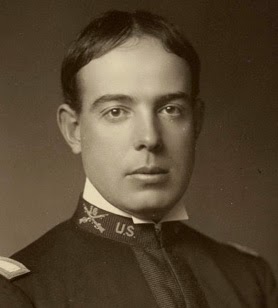
  3. Edward P. Colby was born about 1845. Lieutenant E. P. Colby of the 11th US Infantry shot himself in the head with a pistol on 31 Dec 1869 in Jefferson, Texas. He was 24 years old.
  4. Lucien Redfield Colby died on 14 Sep 1854, at almost three years of age.  He is buried in the Proctor cemetery. 
Laura and Edward Colby
                                                         
Children of Stoddard B. Colby and Ellen Cornelia Hunt:


  1. Ellen Rebecca Colby married Frederick Abbott Stokes on 10 May 1888. Frederick, the son of Frederick Abbott and Caroline Augusta (Allen) Stokes, was born on 4 Nov 1857 in Brooklyn. In 1910 Frederick and Ellen were living in Manhatten with their two sons and Ellen's mother. Frederick was a book publisher. He was president of the publishing house Frederick A. Stokes Co.  some descendants of Ellen Rebecca Colby-----Frederick Colby Stokes was born on 31 May 1884. He died on 22 May 1885. Horace Winston Stokes was born on 2 Mar 1886 in New York He married Mary Sanford Wheeler on 22 May 1920 in Burlington, Chittenden, Vermont.  She was born about 1886 in Vermont. Horace was a book publisher. In 1930 he lived in the Bronx. Frederick Brett Stokes was born on 6 Jan 1888. Frederick graduated from Yale in 1879.
  2. Frank Moore Colby was born on 10 Feb 1865 in Washington, DC. He married Harriet Wood Fowler  about 1897. Harriet was born in Aug 1871 in New Jersey.  He received an AB from Columbia in 1888 and an AM from Columbia in 1889.  He was assistant professor of History at Amherst 1890-91. He was a famous editor.  some descendants of Frank Moore Colby----Georgiana Colby was born in Dec 1897 in New York. Stoddard Colby was born on 27 Nov 1899 in New York City, New York. Harriet F. Colby was born on 20 Oct 1907 in Orange, New Jersey. She married Walter William Beachboard on 17 Dec 1938 in New York City. Walter, the son of Walter William and Anna Louise (Lehman) Beachboard, was born on 14 Oct 1907 in Berkeley, California. Walter was a lawyer.
Frederick Moore Colby
                                                            
  
Frederick Colby Stokes


Asa Bacon Carey was born on 12 July 1835 in Canterbury, Windham, Connecticut. He died on 5 Apr 1912 in Orlando, Orange, Florida

Children of Asa Bacon Carey and Laura Melinda Colby:
  1. Edward Colby Carey was born on 20 Apr 1871 in Santa Fe. He died on 16 or 19 Feb 1948 in Southern Pines, Moore, North Carolina. He married first Ruth Palmer. He married second Anne Kneeland Smith. He married third Caroline Tarver.
  2. Edith Colby Carey was born on 4 Nov 1878 in Washington, DC. She married Gen. Meriwether Lewis Walker on 28 Sep 1904 in Vineyard Haven, Dukes county, Massachusetts. Meriwether was the son of Thomas L. and Catherine M. (Dabney) Walker. He was born on 30 Sep 1869. He died on 29 Jul 1947 in Vineyard Haven.
    Meriwether graduated from the USMA on 12 Jun 1893, in the same class as his brother-in-law. He ranked 3rd out of 51. Gen. Walker was Governor of the Panama Canal Zone from 1924 to 1928. He was then commander of the 18th Army Brigade in Boston and retired to Martha's Vineyard in 1932.
    some descendants of Edith Carey    Thomas Luckey
Ruth Palmer


Laura Caret daughter of Col. Edward Colby Carey and Ruth Palmer and her husband Major General Edwin Luther Sibert


CAPT. NEHEMIAH COLBY Signature


Stoddard B Colby Friday, October 4, 1867 Paper: Caledonian (St. Johnsbury, VT) Page: 3 


THOMAS WALKER LUCKEY

written by David Finkle From the Archives and Colby Family Genealogy


Born: January 6, 1940
Died: August 19, 2012
Thomas Walker Luckey, for whom life often seemed child's play due to his designing complex structures known as Luckey Climbers for youngsters, died Sunday, August 19, 2012 at Yale-New Haven Hospital of pneumonia complications. He was 72.
His demise came shortly after he was an effervescent presence at the class's 50th Reunion, undeterred by his attending in the wheelchair he'd occupied as a result of a tumble from a second-floor window to an interior courtyard in 2005 and about which he was quoted as saying - typically, many will attest - "falling on my head was the best thing that ever happened to me."
A Branford, Connecticut resident for many years, his obituary in the Branford Patch included this paragraph: "Tom Luckey was a visionary, a creative genius, a legendary optimist, an exuberant showboat, and an infamous fun-maker. He was an avid collector of friends, regardless of age; all that mattered was whether you were willing to take a leap with him toward his ultimate goal: superlative joy."
In recognition of the sculptural staircases, toy and carousel designs but mostly in a nod to the colorful one-of-a-kind climbers that were alluring to children and adults, curators Aidan O'Connor and Juliet Kinchin of the Museum of Architecture and Design wrote in a tribute, "The designs are exuberant, even miraculous, incorporating stable platforms suggestive of magic carpets, leaves, or other organic shapes that seem to float in space while encouraging unfettered ascension."
Lou Casagrande, president and former chief executive officer of the Boston Children's Museum, which owns one of the climbers and considers it the establishment centerpiece, said of Luckey, "There is probably no person in my museum career who inspired me more, both as an artist and as a courageous and outrageous champion of children as path seekers and creators of their own joy. He's the best. Scratch him, and he's still five years old, with that innate sense of fun."
Robert A. M. Stern, dean of the Yale School of Architecture, said on hearing of the death that Tom was "possessed of talent, and it will carry on, no matter what."
Tom was born to Robert Burneston Luckey, Lt. Gen. USMC, and Cary Dabney Walker in Quantico, Virginia on January 6, 1940. His paternal grandparents were George P. Luckey and Alice Owens and his maternal grandparents were General Merriwether Lewis Walker and Edith Colby Carey.
When young, he was already working with his hands. Starting with small carvings, he advanced to bigger undertakings that included when he was sixteen a small Martha's Vineyard cottage.
He prepared at Camp Lejeune High School in North Carolina and Westminster. At Yale he was a member of Calhoun, Delta Kappa Epsilon and Desmos.. He was also on the freshman swimming team, the Calhoun football team and in P. L. C. (lance corporal). He earned his BA and then his M. Arch. at the Yale School of Architecture.
Tom is survived by his wife, Ettie Minor Luckey, and their children, daughter Kit and son Walker, as well as two older children, daughter Owen and son Spencer, from his first marriage to Elizabeth T. Mason.
Always cogitating about design, Tom thought up and built what was referred to as "The Luckey Table." It's a dining table that expands from six places to ten and has been described by antiques expert Robert Porter, a former Yale College dean, as "the first development in the expandable dining room table since Duncan Phyfe."
On his Lucky LLC website, Tom proclaims, "What I'm probably doing [is] going for the big high — the plateau where the pieces will sing together and the energy explode. My idea of perfect is to be listening to the absolute truth calling back from the thing I'm making and to have enough sense, enough humility, enough humanity, to hear it."

Saturday, November 15, 2014

Farrar Pottery

This family was full of talent! Although I found the pottery they crafted I have only some of the genealogy. If you have any information or pictures of descendants please post or e-mail me Thanks

Isaac Brown Farrar the third son of Rev. Stephen Farrar bom March 27, 1771, married Anna or Alma Lawrence, daughter of Dr. Ebenezer, Lawrence, of Pepperell, He lived in New Ipswich, merchant, Innholder, and Militia Officer, removed to Fairfax, Vt., where he died 1838
Ebenezer Lawrence
Stephen married Anna Muzzy, his cousin;
Ephraim Hartwell
Isaac, married Eveline Farrar of Middlebury, Vt.
Caleb Farrar, the 7th son of Rev. Stephen Farrar born June 1780, married Sarah Parker of New Ipswich, March 15, 1804, and lives at Middlebury, Vt.   More family below in post

Political Stoneware Jug, Abraham Lincoln "Old Abe Prest" Brushed in Cobalt, One Gallon Lyman Stone - Waterbury VT - 1862 - Old Abe Prest Unique cobalt decorated stoneware jug impressed S. Johns Stoneware under spout; the factory was operated by George W. Farrar in 1862. Lyman Stone (1800 - 1870) listed in 1850 census   blacksmith in Waterbury. One of only three extant pieces of stoneware referencing Lincoln.  $18,985


Farrar, 1850's 5 gallon butter churn with triple flower design all in great blue. Sold for $850 at Waasdorp's American pottery auction on 10/2010.


W. H. FARRAR / GEDDES, NY Stoneware Jug with Exceptional Slip-Trailed Bird and Floral Decoration 
March 1, 2014 Stoneware Auction by Crocker Farm, Inc.


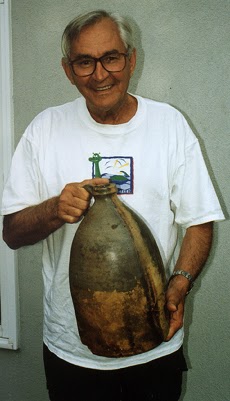
Wile scuba divng, July 27 1997, facing "Belmere", which was once Sir Huh Allan's residence on Lake Memphremagog, he found a two gallon jug. It bore the insription "E.L. & G.W. Farrar, Fairfax, VT." He realized he had found an artifact that could be as much as 150 years old and certainly part of his distric's heritage.Treasures ....in Memphremagog lake by Jacques Boisvert- President August 1997


Jacques Boisvert notes: A bill of sale is shown dating August 26 1840, from the VERMONT STONE WARE firm, owned by Georges W. & J. H. Farrar of Fairfax, Vermont. From that bill we note that the 2 gallon jug was selling for $43.00 a dozen, which is about $0.35 each.
The father Isaac Farrar started pottery business. He was in Enosburgh, VT, in 1798. Farrar was the first clerk of that town and his daughter was the first white child born there. We do not know in which year he moved to Fairfax, but according to a jug kept at the Brooklyn Museum (NY) marked I.B. Farrrar & Sons, we may guess that it was around 1815, as his sons would not have been old enough then to be in business with their father.
His son Ebenezer Lawrence (E.L.) and the one bearing the initial J.H. were in business in 1840 as the bill noted mentions.Eventually Ebenezer Lawrence (E.L.). bought the Farrar & Soule pottery at St. John, Quebec and George Whitefield (G.W.) Farrar. his brother became associate with him in 1857.
In a small publication entitled: LA POTERIE AU QUÉBEC, une histoire de famille we can read: "It is impossible in the first years of "Farrar pottery", to trace a clear demarcation line between the activities of the Canadian and American Farrarr. The story of these potters of St. John, Quebec is closely related to the potters of Vermont. Two Farrar brothers, died in the burning of a steamboat on the St. Lawrence River. This ship bore the name "THE ST.LAWRENCE". They were among 200 victims that loss their life in that incident.
 

Some Information recorded from Canadian Biography
 

George Whitefield Farrar potter; b. 29 April 1812 at Fairfax, Vt, son of Isaac Brown Farrar and Alma Lawrence; m. 25 Sept. 1836 Sophia Adams Winslow at Barre, Mass., and they had three sons and one daughter; He d. 28 Jan. 1881 at Iberville, Que
 

George Whitefield Farrar came of a family whose roots in North America went back to the 17th century, to Jacob Farrar, who emigrated from England to Massachusetts in or about 1653. In the 18th century George’s father settled in Vermont and eventually established a pottery at Fairfax. It was at this pottery that George received his training.

He continued as a potter in Fairfax until the 1850s, when he crossed the Canadian border to Saint-Jean (Saint-Jean-sur-Richelieu). Other members of the extensive Farrar clan had for some years been engaged in potting there and had introduced the making of stoneware to the area. In 1857 he entered into a partnership in Saint-Jean with his potter-brother, Ebenezer Lawrence Farrar. The partnership was announced in the Saint-Jean News and Frontier Advocate as effective from 13 April 1857. It was short-lived, for less than three months later Ebenezer lost his life in the burning of the steamboat Montréal on the St Lawrence. George W. Farrar carried on the business in Saint-Jean, and across the Richelieu River at Iberville after fire destroyed the Saint-Jean plant in 1876. He was joined, when they were old enough, by his sons; the two who had most to do with the pottery were George Henry and Ebenezer Lawrence. At various periods the pottery was officially operated under his sons’ names, but he always maintained an interest in it. After his death it continued in the family name until 1926 when George H. Farrar sold it. The pottery closed in the early 1930s.

The Farrars’ products were the common earthenware and stoneware of the North American potter Articles produced were almost entirely utilitarian: snuff jars, bottles, spittoons, jugs, teapots, butter pots. Within this range, quality was good. George W. Farrar was awarded a medal for earthenware at the provincial fair in Montreal in 1860; under his sons’ names the factory’s stoneware was exhibited abroad, at Philadelphia (1876) and Paris (1878). In 1861 the pottery used up some 500 tons of clay (stoneware clay was imported from New Jersey) and employed 18 hands. By the 1870s steam power had been installed and 40 persons were on the payroll; the pottery was now one of the largest in Canada.

But George W. Farrar’s accomplishments did not end with the production of dark-bodied earthenware and salt-glazed stoneware. He was the promoter of the St Johns Stone Chinaware Company, the first whiteware pottery in Canada, established in 1873. Because, like most Canadian potters, Farrar never made much money, he lacked capital to embark on such an ambitious venture as the formation of the company on his own, but his was the moving spirit behind it. 


Much of the required capital came from Edward C. Macdonald, the company’s president and a “merchant prince” of Saint-Jean, who bought the company outright when it slipped into bankruptcy in 1877. Farrar himself was connected with it for only a brief period – he withdrew early to take back the management of his own pottery – yet his had been the vision of a new dimension in Canadian potting: the first commercial production of whiteware.

The News and Frontier Advocate summed up his importance when George W. Farrar, a former councillor of Saint-Jean, died in 1881: “Mr. Farrar encountered many difficulties in this country but he was . . . ever enthusiastic in his schemes. He was undoubtedly the promoter of the St. Johns Chinaware . . . factory, which is at present doing such a large and flourishing business and as he was but a short time connected with the concern, its lack of success at the outset cannot certainly be laid to his charge.” 


A beautifully decorated two gallon jug from E.L. & M (Ebenezer Lawrence and Moses) Farrar of St. Johns Canada East. Circa 1855. Decorated pieces from this short-lived early partnership are rare. The quality of this design suggests it may have been a special piece. The initials "N.M" are the potter's.  

Farrar Redware Crock Made at L.W. Farrar Pottery (1831-1850), Fairfax. Incised mark: "L. W. Farrar."
FAIRFAX POTTERY FALLS INTO 2 CATEGORIES:
1 - Red Earthware fashioned from native clay. Native clay was found in river beds and near large bodies of water.
Redware is one of the least durable ceramic types. Porous and brittle, it easily cracked and chipped. Red earthware has not survived in quantity. It was intended for the humbler domestic purposes. The local glacial clay was also used for common bricks.

2 - Stoneware made with materials brought from outside the New England states. This material was transported from New York, New Jersey and Pennsylvania.
Isaac Brown Farrar, son of Rev. Stephen Farrar, was born March 27, 1771. He was born and raised in Ipswich, N.H. He left New Hampshire in the year 1798. I.B. Brown was a potter.
Isaac Broun Farrar appeared in Enosburgh, VT in 1798. No one knows when he appeared in Fairfax, VT. I.B. Farrar had a son, Isaac Brown, who married Eveline Farrar, a cousin.
Eveline's father was Caleb Farrar of Middlebury, VT. Caleb was a well-known potter.
Other sons were Ebenezer Lawrence, Stephen and George W. J. H. Farrar (1840) may stand for another of Isaac's boys.
Records indicate that Isaac Broun Farrar, Sr. died in 1838 at 67 years of age.
Ebenezer Lawrence Farrar did business under his own name and also in partnership with G. W. Farrar.
In 1852 E. L. Farrar was in Burlington, VT., where he built a pottery work for the firm of Nichols and Alford.
Another Farrar, whose given name has not come to light was in partnership with one Stearns in 1851 and 1852. He may have been the son of Ebenezer Lawrence Farrar. Farrar & Stearns can be found on pottery. They made stoneware.
Lewis & Cady were also stoneware manufacturers. Pottery with their names can also be found.
Bostwick was also a name associated with Fairfax Pottery. Fairfax Historical Society has a piece of Bostwick Stoneware.
Below are some of the names found on Local Fairfax Pottery:

E. L. Farrer
Farrar & Stearns
Lewis & Cady
Fairfax, Vt
Farrar Pottery
E.L. & G.W. Farrar
I. B. Farrar & Son
Farrar & Hubbell
Farrar & Soule
S. H. & G. W. Farrar
Farrar & Woodworth

The above information was provided by Marvin Alderman, formerly of Fairfax who is extremely knowledgeable of pottery. "ONONDAGA - POTTERY CO. 1841, in Syracuse, New York, W. H. Farrar operated a pottery to make Rockingham. 1855 -1871, the plant was called the Empire Pottery. 1871, the plant was re-organized and the name changed to Onondaga Pottery Co. 1966, the name became Syracuse China Onondaga Pottery made china dinnerware.

In The Pottery and Porcelain of the United States: An Historical Review of American Ceramic Art from the Earliest Times to the Present Day E A Barber notes:
Caleb Farrar established a pottery in Middlebury, Vermont, about 1812, for the manufacture of earthenware and white tableware. About 1850 Farrar sold the works to James Mitchell, who continued the business until his death, after which the pottery was purchased by Nahum Parker. The buildings were afterwards converted into a dwelling house, which is now or was recently occupied by Mr. P. V. Hathaway, who married a member of the Farrar family. Among other varieties of ware, green glazed pottery was at one time produced there. A specimen may be seen in the collection of the Pennsylvania Museum, Philadelphia. This is a mug of common earthenware covered with a yellowish, apple-green glaze.

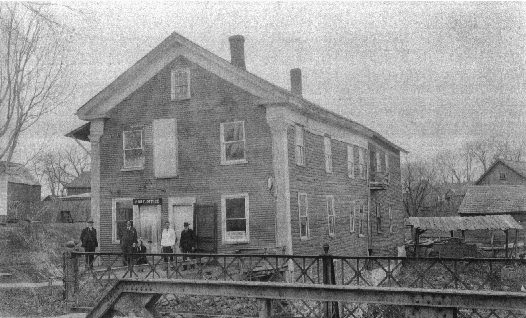
This building that used to be just below the Koch House is thought to have been the Farrar Pottery Business at one time Vermont Historical Society 


Engraving E. L. & G. W. Farrar, Pottery John Henry Walker (1831-1899)1853, 19th century
See Alfred K. Ballard Pottery Co. Collection From Marjorie P. Kohli, Waterloo, Ontario, Canada, 1999


4 gallon jug made by the W. H. Farrar & Co, with the incredible full bodied dotted rooster decor, just sold for $11,750.00 - This one was manufactured in Geddes, N.Y, not Fairfax, but by the same company that originated in Fairfax then expanded and moved to both St. John's, P.Q., Canada and Syracuse, N.Y. 


For more images Skinner Auctions 
"Early New England Potters and their Wares"
American Stoneware by William C. Ketchum, published by Henry Holt and Company, 1991

Lords of the North By James K. McDonell, Robert Bennett Campbell

Elizabeth Collard

Friday, October 10, 2014

Thaddeus Sobieski Coffin Revere, MA


                 Thaddeus Sobieski Coffin of Revere, was born in Harrington, Me., in 1838.

He is a descendant in the seventh generation of Tristram Coffin and Dionis Stevens.
Their son, Lieutenant John Coffin, born in Haverhill in 1647, married Deborah, daughter of Joseph and Sarah Austin. He settled in Nantucket, and after living there for several years removed to Edgartown, where he resided till his death. He filled minor offices at Nantucket, and was a Lieutenant in the militia at Edgartown.

Tristram Coffin was born in Nantucket, and married there in 1714 Mary Bunker. He was a lifelong resident of the island, where he died in 1763. Richard Coffin, who was born in Nantucket in 1729, married Mary Cook. Temple Coffin, born in Addison, Me., married Ann Thorndike.


Coffins were among Harrington’s earliest settlers, and several generations contributed significantly to the development and industry of the town. E. S. Coffin was one of the first merchants in Harrington village. Temple, John B., Adams, and Capt. Voranus L. Coffin were all shipbuilders. In 1876 V. L. Coffin purchased the interests of his partners, and in 1884 the company became V. L. Coffin and Son; his son was Charles A. Coffin. Their business interests included the general store shown in this c. 1910 photo. V. L. Coffin and Son’s Store later became K. A. Smith General Store and then Anderson’s General Store. By the 1920s a three-story building stood on the site of the two small buildings next to the store. At various times that building was Self’s Drug Store, Hall’s Drug Store, and Scott’s Variety. The buildings are currently vacant.  Caption information provided by Glendon Carter

John B.Coffin was born in Harrington, Me. in 1812. He was engaged in ship building for several years, and then followed agriculture on his farm in Harrington, where he died in 1878.
His wife, whose maiden name was Ruby Strout, was born in Harrington, Me., a daughter of Deacon Benjamin Strout. She died in 1849, they had four children—Delia, Thaddeus, Helen, and John. John married for his second wife Lucy Cates, by whom he had two children — Frank D. and James.

Thaddeus S. Coffin was educated in the public schools of his native town and the academy at East Machias. After leaving school he taught for eight years. He then engaged in business in Harrington, and so continued till 1869, when he came to Boston and entered the employ of Mr. Simmons (proprietor of Oak Hall) as salesman. The latter position he soon resigned to engage in the manufacture of jewelry cases, which business he carried on for thirteen years. In 1883 he settled in Revere, Mass., and he purchased real estate, which he began to improve. He has been prominently identified with the up building of the town, especially that part of it known as Beachmont. He married first, in 1863, Miss Augusta Nash. She died in the town of Harrington, Me., in 1869, leaving two daughters — Carrie and Elizabeth. Carrie, who was a graduate of the State Normal School, d. in 1886. Elizabeth, who was a prominent teacher in Revere for several years, married Edward Parker, and lived in Boston, and has one daughter, Helen Coffin Parker. Mr. Coffin married for his second wife Abbie F. Whitmarsh, of Dighton, Mass. He has always taken an interest in educational matters, and served several years as a member of the Revere School Board.


Monday, July 28, 2014

William Lloyd Garrison Mob Boston 1835

The lock which was used to secure Garrison in a prison, for his protection from men who wanted to lynch him, during the October, 1835 mob action.

From The Liberator Files 1831-1865


A Moment in Abolition History

A view by Horace Seldon

Often history records an event which later is seen as a crucial “moment”, filled with meaning beyond the specific time, place and personalities involved. Such a time happened in London, in June, 1840. In another place I’ve written about the international significance of that time, when Garrison and other men from New England refused to participate in an international anti-slavery convention, because women delegates had been denied recognition. The effect on the movement became significant as a “watershed moment”.

In Boston, in 1835, a similarly significant “moment” occurred, once again with William Lloyd Garrison at the center, this time encountered by an angry “mob”. To tell the story I will rely on Garrison’s own words, on the historical accounts of Henry Mayer, and of Garrison’s sons, Wendell Phillips Garrison, and Francis Jackson Garrison. Any particular “moment” has a historical context, and the year 1835, is a time which Garrison himself called a “reign of terror”, threatening individual abolitionists and the movement itself. See Papers to Garrison Mob by Lyman


On the left is Wendell Phillips, son of the City of Boston’s first mayor, eloquent Abolition speaker; Garrison in the middle; on the right, George Thompson, English Abolition leader, close collaborator with Garrison. The Garrisons named two of their sons after Phillips and Thompson. Photo from Rare Book Room Boston Public Library

In New England in premonition of “terror”, late 1834 saw the destruction of Prudence Crandall’s school in Canterbury, Connecticut. She had opened her school for young black women, and that act enflamed a hatred that warned abolitionists of the depth of what previously Garrison had called the “mountains of ice” which needed to be melted. Then came the hot hatred of 1835. In Charleston, South Carolina, a post office was seized by a crowd of people who seized mailbags full of anti-slavery pamphlets; the fire which burned the literature became the scene of the hanging of effigies of Arthur Tappan and Garrison. In Nashville, Amos Dresser, a young man who had joined abolitionist protests at Lane Seminary, was publicly assailed and lashed twenty times in the public market.


Prudence Crandall (September 3, 1803 - January 28, 1890), a schoolteacher raised as a Quaker, stirred controversy with her education of African-American girls in Canterbury, Connecticut. Her private school, opened in the fall of 1831,was boycotted when she admitted a 17-year-old African-American female student in the autumn of 1833; resulting in what is widely regarded as the first integrated classroom in the United States. She is Connecticut's official State Heroine.

In Canaan, New Hampshire, voters of the town assembled in town meeting, and acted to appoint a committee to oversee the physical removal from the town of Noyes Academy. That Academy had been started to educate young black children, under leadership which included one of Garrison’s devotees, David Child. Also in New Hampshire, in that same year, in a church in Northfield, George Storrs, was lifted from his knees while offering an anti-slavery prayer, and thrown out of the church! This “reign of terror” became very real for Boston, and for Garrison.

George Thompson, strong abolitionist leader from England, had come to the United States in the previous year, and was still touring the country in 1835. His speeches brought strength to the movement here, but he was under constant threat wherever he appeared. At an August speech in Boston abolitionist women had cleverly maneuvered him away from a threatening crowd. In the same month, a stone meant for Thompson, was thrown through a window, where he was speaking, in Lynn. Slaveholder hatred and fear took radical form. Subscriptions to a fund for procuring the heads of Garrison, Thompson, and Tappan, were invited to be made through a bookstore in Norfolk, Virginia. The Richmond Enquirer urged that these “wanton fanatics” be “put down forever”, and warned the North against interference with the right of slavery. Some Northern commercial interests, threatened with the loss of Southern patronage, or the destruction of Southern branches, responded by bringing pressure against abolitionists in Boston.


George Thompson, at age 47, in 1850-1851. United Kingdom abolitionist, close friend and ally to Garrison, after meeting in London, in 1833

One Boston newspaper, the Commercial Gazette, responded to an announcement of an August 14 annual meeting of the Boston Female Anti-Slavery Society, and predicted resistance. “This resistance will not come from a rabble, but from men of property and standing, who have a large interest at stake in this community…” The paper warned ladies to keep away, and threatened that if Thompson were to appear, he would be lynched.

Faneuil Hall was denied for abolitionist meetings, but on August 21, the same Hall was filled with those who wanted to “protect the rights of the South”. Harrison Gray Otis, retired Mayor, was a featured organizer-speaker for that crowded meeting. Otis spoke of the intent of abolitionists to create auxiliary societies in “every state and municipality”, asserting that this proved them to be “imminently dangerous” and “hostile to the spirit and letter of the constitution”. In the same period Samuel May had a speech broken up in Haverhill, and John Greenleaf Whittier was pelted with eggs in Concord. The Garrison family was frightened by a gallows which was planted on the doorstep of their home, on Brighton Street.

The postponed meeting of the Boston Female Anti-Slavery Society, was announced for three o-clock on Wednesday afternoon, October 21st. It was to be held at 46 Washington Street, in a hall at the Anti-Slavery office. The Commercial Gazette reported on the indignation among business men who thought that “women ought to be engaged in some better business than that of stirring up strife between the South and the North on this matter of slavery… they ought to be at home, attending to their domestic concerns …”

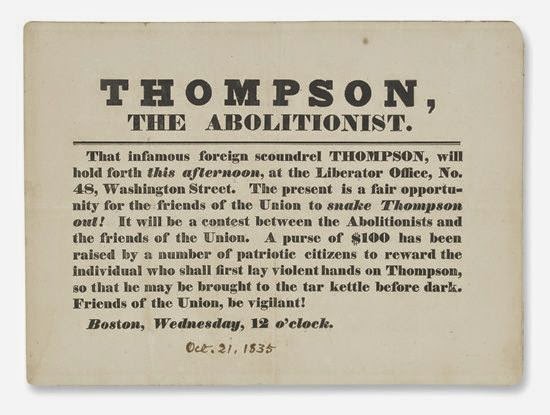
Believing that George Thompson was to speak, anti-abolition forces distributed handbills which urged people to “snake out” Thompson, and offered a one hundred dollar prize for the first to lay violent hands on him. It hoped that Thompson would “be brought to the tar-kettle before dark”. These warnings were widely distributed to insurance offices, hotels, reading rooms, from State Street to the North end. Fearful merchants petitioned Mayor Lyman to prevent the meeting. Photo from Caren Collection


On the day of the meeting, a crowd had gathered along Washington Street, and in the vicinity of City Hall. Hisses, sarcastic cheers, racial epithets were accompanied by demands for “Thompson”. The crowd was assured by the Mayor, who had arrived, that Thompson was not in the building. Word spread soon that Garrison was there. He had come from his home on Brighton Street, where he had hosted a dinner for John Vashon, a leader of the Pittsburgh colored community; he was accompanied by Charles Burleigh, abolitionist from Connecticut. Garrison, after consulting with the women leaders of the meeting, retired into the Anti-Slavery office, separated from the gathering by a partition. (See Letters to John Vashon--Garrison)


The birth of John Bathan Vashon in 1792 is celebrated on this date. He was a Black seaman, businessman and abolitionist. 

The President of the Society, Mary Parker, proceeded with the business of the meeting, with the customary prayers and reading of Scripture. She was interrupted by the Mayor bursting into the room, requesting that the ladies abandon the meeting and go home. A conference between Parker, Maria Chapman, and the Mayor resulted in the decision by the ladies to adjourn the meeting and reconvene at the Chapman home at 11 West Street.

The story then becomes one of a remarkably dignified walk by the women, black and white, arm in arm, six blocks down Washington Street, through an angry mob, still resolute in determination to continue their meeting. It is also the story of a portion of the mob gaining access to the building, grabbing Garrison, and his final release from the crowd by “two burly Irishmen not know as abolitionists”. He was then rushed by constables, into a carriage, and taken to the Leveret Street jail for safety overnight. John Vashon visited Garrison the next morning, where he was in prison, and gave him a hat to replace the one which had been “cut in pieces by the knives of men of propoerty and standing”.

History most often gives emphasis to the threat to Garrison, who was indeed nearly lynched, and could have been killed by some in the mob. Here I want to lift up the courage of the women who walked through that mob, undeterred in the immediate purpose of their meeting, or the overarching purpose of abolition. Here also it is appropriate to some who were present that day who were led to become dedicated abolitionists.

Young Wendell Phillips, son of Boston‘s first Mayor, dated his “conversion” to the abolitionist cause from the day when he witnessed the mob. Henry Ingersoll Bowditch, just returned from medical training in Europe, knowing nothing of Garrison, was also infuriated by the mob’s action against Garrison. He vowed himself an abolitioinst from that moment, and shortly after subscribed to Garrison’s Liberator.


Edmund Quincy, son of the second Mayor, was alerted toward the rights of abolition. His father, Josiah Quincy, then President of the City Council, saw the mob from his office at 27 State Street, rushed to Garrison’s side until he was placed in the carriage and driven off, . Rev. James E. Crawford, later of Nantucket, was walking on State Street and encountered the riotous mob, and “his heart and soul became fully dedicated to the cause of immediate emancipation. Thirty years later, William H. Logan told of how, soon after the mob had left, he had received from Sheriff Parkman, remnants of a pair of pantaloons which had been torn from Garrison. At that same 1855 remembrance of the occasion, William C. Nell reported that a Boston merchant, David Tilden, Esq., “immediately became a subscriber to the Liberator and continued a reader until his death. Reports of several others of the affect of being witness may be suspect, but the affect on Harriett Martineau was widely reported. Martineau, an English teacher, professor, liberator, had been in the country for months, conducting what might be termed a sociological study of slavery. She had interviewed slave owners and abolitionists alike, adhering to her academic style for the most part. On the historic day, she was on her way from Salem to Providence, passing through Boston as the crowd was gathering. Friends, seeing the well-dressed crowd, and knowing it was close to a Post Office, informed her that the crowd was assembled because it was a “busy foreign-post day”. In Providence she heard the factual account. She volunteered her interest and within a few weeks she was a speaker at the Society. In December she visited Garrison in Boston, and became a worthy supporter.


This date, October 21, 1835 is worthy of celebration as a “moment” of gathering strength for the Abolition Movement in the United States. Five years later, in London, came a similarly significant “moment” of strength for abolitionists in the United Kingdom. In that “moment”, a major issue revolved around what some have called the “woman” question.

Public Sentiment at the North Date: Saturday, March 7, 1835  Liberator (Boston, MA) 


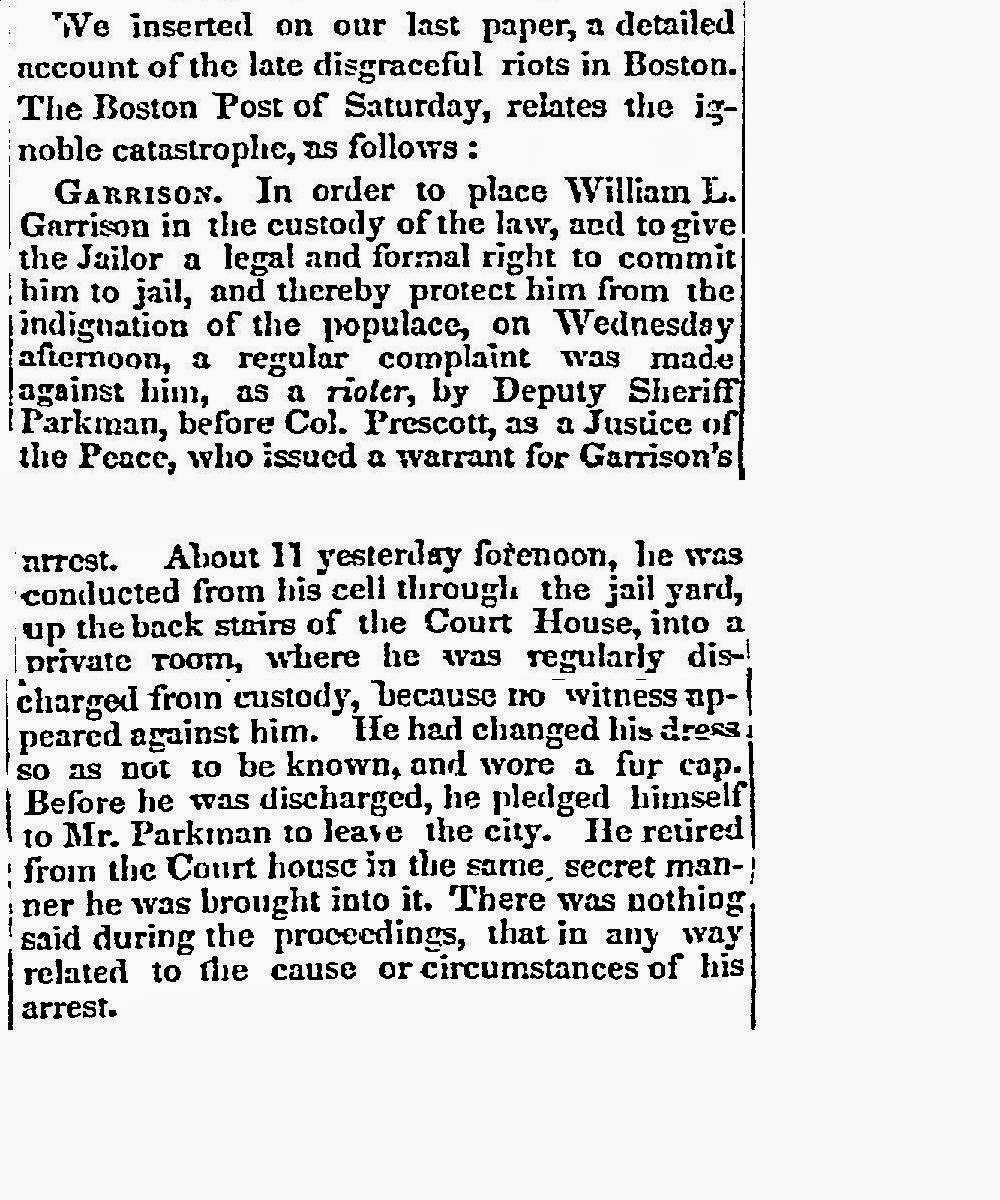
 [Boston; Post; Saturday; Garrison; William L. Garrison; Jailor; Wednesday; Deputy; Sheriff; Parkman] Tuesday, October 27, 1835  Salem Gazette (Salem, MA)


Other Reads

Popular Post