Showing posts with label Abraham Lincoln. Show all posts

Saturday, August 26, 2017

A Rare Cane with Paper Trail From Abraham Lincoln to Charles Sumner to Mrs Hastings and Major Ben: P Poore


A Cane presented to President Lincoln was one of the relics owned by Major Ben: Perley Poore at his home, Indian Hill Farm in West Newbury, Massachusetts. Currently In A Private Collection. 


A Post card of Indian Hill Farm Estate in West Newbury, Massachusetts occupied by Ben: Perley Poore.


Portrait of President Abraham Lincoln. The background scene depicts ships of war. In a New Hampshire Private Collection.

The cane is most likely designed by John C Nobles of Rushford, New York, and presented to President Abraham Lincoln in 1864. There are two copies of correspondences answering queries on the cane. One from the United States Office of Commerce Patent Office and the other from United States Office of Interior Park Service in 1965 (provided by the current owner). The letters suggest the cane was a design by Nobles, but no direct match has been made to Lincoln. However, there are letters, memorial sketches, and newspaper clippings that reveal a direct association.  


John C Nobles Patents are listed in the Smithsonian Archives, Scientific American, House Documents, Otherwise Published as Executive Documents: 13th Congress, 2d Session-49th Congress, 1st Session, Volume 10, Part 1, Commissioner of Patents Annual Report. In August of 1862, Nobles is listed with a Thomas Birch, under the firm of Birch & Nobles in Annual Report of the Commissioner of Patents, Part 1, Volume 1

I was able to establish a paper trial from Lincoln to Major Poore. However, I am not finding a date or place on when Lincoln actually was presented with the cane.

First, the cane was gifted to Senator Charles Sumner (1811-1874) via Mary Todd Lincoln (1818-1882) wife of Abraham Lincoln

In a letter dated May 9 1865, From Mrs. Lincoln to Sumner:


From Memoir and Letters of Charles Sumner, Volume 4 Edward Lillie Pierce 
   
The cane is not described in this letter, but after Sumner's death in 1874 the cane is detailed when it went to Mrs Hastings, sister of Sumner. 

This would be his sister Julia Sumner (1827-1876) who married to Dr. John Hastings (1814-1891) in 1854 and moved to San Fransisco, California. She was named in Sumner's will, along with her daughters. (Charles Edwards Lester, Life and Public Services of Charles Sumner, pg 684-685)


According to "The Memoir and Letters of Charles Sumner, Volume 1," Julia dealt with poor health, but her last visit to the Atlantic States was in 1862.  She visited Washington at that time. Her brother Charles accompanied her to New York, and parted with her at the steamer, as she sailed on her return. "I shall never forget," Julia afterwards wrote, "his tender care at that time. My last sight of him was standing on the wharf as the steamer moved off." (Edward Lillie Pierce, pg. 34)

In 1874, Julia Sumner Hastings presented the cane to Major Ben: P Poore. 


The cane presented to President Lincoln, who gifted it to Senator Sumner. Sumner left the cane to his sister, who gifted it to Poore. Saturday May 12 1883 page 3 Evening Star Washington District of Columbia Springfield Republican December 24 1874 

Charles Sumner, son of Charles Pinckney Sumner and Relief Jacobs was described as "the most elegantly tailored man in House or Senate," who "resembled Lord Chatham more closely than any statesman of the nineteenth century."  He had a "handsomely modeled head, wavy locks of hair, and sideburns." (Gingberg)

Ben: Perley Poore in his youth. Poore had beautiful features and a was a prolific writer. There is a similarity to Lord Byron. Portrait from Indian Hill now in private collection


Autograph sentiment signed: "With the regards of/ Ben: Perley Poore/ Indian Hill Farm, near/ Newburyport, Sept. 26, 1878"  Newburyport, Massachusetts. September 26, 1878.


In Major Poore's obituary the cane is mentioned, from The Burlington Free Press and Times   


Boston Post June 15 1887 Will of Ben: P Poore's Will and Locket containing Sumner's hair to Charles Wesley Slack, abolitionist, temperance advocate, editor and proprietor of the newspaper The Boston Commonwealth.


Obit for Charles Sumner Saturday, December 15, 1894 Sacramento Daily Union (Sacramento, California) Page: 8

A fun tidbit from 1902: The locals resurrected the famous "Savages," a battalion formed by Major Poore which became the Nineteenth Massachusetts Regiment. Organization of the "Savages" from The Boston Post 1920 mention Ben: P P Moseley, Paul N. Hale, Stephen Noyes, Henry D. Lay, Shubel Rogers, Carleton Moody, Richard Newhall, Joseph Floyd, E. Moody Boyton, and Carrie H Marsh.

  • Abraham Lincoln: The Prairie Years and the War Years Carl Sandburg Sterling Publishing Company, 2007
  • Nason, Elias. The Life and Times of Charles Sumner: His Boyhood, Education, and Public Career

Sunday, May 10, 2015

General Grenville Mellon Dodge Corps Commander Civil War

January 4 1916 Article See Laura George Fort Dodge, Home of Heroes 
Gen Dodge b. April 12, 1831 son of Sylvanus Dodge and Julia Theresa Phillips Dodge. From the time of his birth until he was 13 years old, Dodge moved frequently while his father tried various occupations. In 1844, Sylvanus Dodge became postmaster of the South Danvers office and opened a bookstore. While working at a neighboring farm, the 14-year-old Grenville met the owner's son, Frederick W. Lander, and helped him survey a railroad. Lander was to become "one the ablest surveyors of the exploration of the West," according to Charles Edgar Ames in Pioneering the Union Pacific. Lander was impressed with Dodge and encouraged him to go to his alma mater, Norwich University (in Vermont). Dodge prepared for college by attending Durham Academy in New Hampshire
In 1851, he graduated from Norwich University with a degree in civil engineering, then moved to Iowa, where he settled in the Missouri River city of Council Bluffs. For the next decade, he was involved in surveying for railroads, including the Union Pacific. He married Ruth Anne Browne on May 29, 1854. He was also a partner in the Baldwin & Dodge banking firm, and in 1860 served on the Council Bluffs City Council. 


General John H. Ketchum, New York, General James A. Garfield, General Grenville M. Dodge, Honorable Thomas H. Boyd, Pennsylvania, Honorable James A. Pyle, General Green B. Raum, Illinois, E.V. Smalley, Honorable Henry D. Washburn, Indiana From Naval Archives 


Ruth Anne Brown was born on May 23, 1833, in Peru, Illinois. d. of  Warren Browne (1792 - 1855) and Ruth Ann Kinney Browne (1790 - 1859)


The Black Angel - Ruth Anne Dodge Memorial From Iowa Civil War Monuments
Ruth Anne Dodge, wife of General Grenville Dodge, had a dream or vision shortly before she died in 1916. This vision had an angel at the prow of a boat carrying a small bowl and extending her other arm toward Mrs. Dodge. The daughters of the Dodges commissioned a sculptor, Daniel Chester French, to design a monument based on this vision. French is best known as the designer of the seated Lincoln in the Memorial in Washington D. C. The bronze statue is known as the Black Angel. It is adjacent to Fairview Cemetery on Lafayette Avenue.


Grenville Dodge (1831-1916) by David Lotter

Saturday, November 15, 2014

Farrar Pottery

This family was full of talent! Although I found the pottery they crafted I have only some of the genealogy. If you have any information or pictures of descendants please post or e-mail me Thanks

Isaac Brown Farrar the third son of Rev. Stephen Farrar bom March 27, 1771, married Anna or Alma Lawrence, daughter of Dr. Ebenezer, Lawrence, of Pepperell, He lived in New Ipswich, merchant, Innholder, and Militia Officer, removed to Fairfax, Vt., where he died 1838
Ebenezer Lawrence
Stephen married Anna Muzzy, his cousin;
Ephraim Hartwell
Isaac, married Eveline Farrar of Middlebury, Vt.
Caleb Farrar, the 7th son of Rev. Stephen Farrar born June 1780, married Sarah Parker of New Ipswich, March 15, 1804, and lives at Middlebury, Vt.   More family below in post

Political Stoneware Jug, Abraham Lincoln "Old Abe Prest" Brushed in Cobalt, One Gallon Lyman Stone - Waterbury VT - 1862 - Old Abe Prest Unique cobalt decorated stoneware jug impressed S. Johns Stoneware under spout; the factory was operated by George W. Farrar in 1862. Lyman Stone (1800 - 1870) listed in 1850 census   blacksmith in Waterbury. One of only three extant pieces of stoneware referencing Lincoln.  $18,985


Farrar, 1850's 5 gallon butter churn with triple flower design all in great blue. Sold for $850 at Waasdorp's American pottery auction on 10/2010.


W. H. FARRAR / GEDDES, NY Stoneware Jug with Exceptional Slip-Trailed Bird and Floral Decoration 
March 1, 2014 Stoneware Auction by Crocker Farm, Inc.


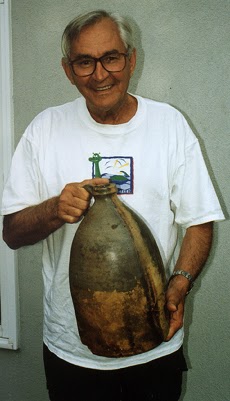
Wile scuba divng, July 27 1997, facing "Belmere", which was once Sir Huh Allan's residence on Lake Memphremagog, he found a two gallon jug. It bore the insription "E.L. & G.W. Farrar, Fairfax, VT." He realized he had found an artifact that could be as much as 150 years old and certainly part of his distric's heritage.Treasures ....in Memphremagog lake by Jacques Boisvert- President August 1997


Jacques Boisvert notes: A bill of sale is shown dating August 26 1840, from the VERMONT STONE WARE firm, owned by Georges W. & J. H. Farrar of Fairfax, Vermont. From that bill we note that the 2 gallon jug was selling for $43.00 a dozen, which is about $0.35 each.
The father Isaac Farrar started pottery business. He was in Enosburgh, VT, in 1798. Farrar was the first clerk of that town and his daughter was the first white child born there. We do not know in which year he moved to Fairfax, but according to a jug kept at the Brooklyn Museum (NY) marked I.B. Farrrar & Sons, we may guess that it was around 1815, as his sons would not have been old enough then to be in business with their father.
His son Ebenezer Lawrence (E.L.) and the one bearing the initial J.H. were in business in 1840 as the bill noted mentions.Eventually Ebenezer Lawrence (E.L.). bought the Farrar & Soule pottery at St. John, Quebec and George Whitefield (G.W.) Farrar. his brother became associate with him in 1857.
In a small publication entitled: LA POTERIE AU QUÉBEC, une histoire de famille we can read: "It is impossible in the first years of "Farrar pottery", to trace a clear demarcation line between the activities of the Canadian and American Farrarr. The story of these potters of St. John, Quebec is closely related to the potters of Vermont. Two Farrar brothers, died in the burning of a steamboat on the St. Lawrence River. This ship bore the name "THE ST.LAWRENCE". They were among 200 victims that loss their life in that incident.
 

Some Information recorded from Canadian Biography
 

George Whitefield Farrar potter; b. 29 April 1812 at Fairfax, Vt, son of Isaac Brown Farrar and Alma Lawrence; m. 25 Sept. 1836 Sophia Adams Winslow at Barre, Mass., and they had three sons and one daughter; He d. 28 Jan. 1881 at Iberville, Que
 

George Whitefield Farrar came of a family whose roots in North America went back to the 17th century, to Jacob Farrar, who emigrated from England to Massachusetts in or about 1653. In the 18th century George’s father settled in Vermont and eventually established a pottery at Fairfax. It was at this pottery that George received his training.

He continued as a potter in Fairfax until the 1850s, when he crossed the Canadian border to Saint-Jean (Saint-Jean-sur-Richelieu). Other members of the extensive Farrar clan had for some years been engaged in potting there and had introduced the making of stoneware to the area. In 1857 he entered into a partnership in Saint-Jean with his potter-brother, Ebenezer Lawrence Farrar. The partnership was announced in the Saint-Jean News and Frontier Advocate as effective from 13 April 1857. It was short-lived, for less than three months later Ebenezer lost his life in the burning of the steamboat Montréal on the St Lawrence. George W. Farrar carried on the business in Saint-Jean, and across the Richelieu River at Iberville after fire destroyed the Saint-Jean plant in 1876. He was joined, when they were old enough, by his sons; the two who had most to do with the pottery were George Henry and Ebenezer Lawrence. At various periods the pottery was officially operated under his sons’ names, but he always maintained an interest in it. After his death it continued in the family name until 1926 when George H. Farrar sold it. The pottery closed in the early 1930s.

The Farrars’ products were the common earthenware and stoneware of the North American potter Articles produced were almost entirely utilitarian: snuff jars, bottles, spittoons, jugs, teapots, butter pots. Within this range, quality was good. George W. Farrar was awarded a medal for earthenware at the provincial fair in Montreal in 1860; under his sons’ names the factory’s stoneware was exhibited abroad, at Philadelphia (1876) and Paris (1878). In 1861 the pottery used up some 500 tons of clay (stoneware clay was imported from New Jersey) and employed 18 hands. By the 1870s steam power had been installed and 40 persons were on the payroll; the pottery was now one of the largest in Canada.

But George W. Farrar’s accomplishments did not end with the production of dark-bodied earthenware and salt-glazed stoneware. He was the promoter of the St Johns Stone Chinaware Company, the first whiteware pottery in Canada, established in 1873. Because, like most Canadian potters, Farrar never made much money, he lacked capital to embark on such an ambitious venture as the formation of the company on his own, but his was the moving spirit behind it. 


Much of the required capital came from Edward C. Macdonald, the company’s president and a “merchant prince” of Saint-Jean, who bought the company outright when it slipped into bankruptcy in 1877. Farrar himself was connected with it for only a brief period – he withdrew early to take back the management of his own pottery – yet his had been the vision of a new dimension in Canadian potting: the first commercial production of whiteware.

The News and Frontier Advocate summed up his importance when George W. Farrar, a former councillor of Saint-Jean, died in 1881: “Mr. Farrar encountered many difficulties in this country but he was . . . ever enthusiastic in his schemes. He was undoubtedly the promoter of the St. Johns Chinaware . . . factory, which is at present doing such a large and flourishing business and as he was but a short time connected with the concern, its lack of success at the outset cannot certainly be laid to his charge.” 


A beautifully decorated two gallon jug from E.L. & M (Ebenezer Lawrence and Moses) Farrar of St. Johns Canada East. Circa 1855. Decorated pieces from this short-lived early partnership are rare. The quality of this design suggests it may have been a special piece. The initials "N.M" are the potter's.  

Farrar Redware Crock Made at L.W. Farrar Pottery (1831-1850), Fairfax. Incised mark: "L. W. Farrar."
FAIRFAX POTTERY FALLS INTO 2 CATEGORIES:
1 - Red Earthware fashioned from native clay. Native clay was found in river beds and near large bodies of water.
Redware is one of the least durable ceramic types. Porous and brittle, it easily cracked and chipped. Red earthware has not survived in quantity. It was intended for the humbler domestic purposes. The local glacial clay was also used for common bricks.

2 - Stoneware made with materials brought from outside the New England states. This material was transported from New York, New Jersey and Pennsylvania.
Isaac Brown Farrar, son of Rev. Stephen Farrar, was born March 27, 1771. He was born and raised in Ipswich, N.H. He left New Hampshire in the year 1798. I.B. Brown was a potter.
Isaac Broun Farrar appeared in Enosburgh, VT in 1798. No one knows when he appeared in Fairfax, VT. I.B. Farrar had a son, Isaac Brown, who married Eveline Farrar, a cousin.
Eveline's father was Caleb Farrar of Middlebury, VT. Caleb was a well-known potter.
Other sons were Ebenezer Lawrence, Stephen and George W. J. H. Farrar (1840) may stand for another of Isaac's boys.
Records indicate that Isaac Broun Farrar, Sr. died in 1838 at 67 years of age.
Ebenezer Lawrence Farrar did business under his own name and also in partnership with G. W. Farrar.
In 1852 E. L. Farrar was in Burlington, VT., where he built a pottery work for the firm of Nichols and Alford.
Another Farrar, whose given name has not come to light was in partnership with one Stearns in 1851 and 1852. He may have been the son of Ebenezer Lawrence Farrar. Farrar & Stearns can be found on pottery. They made stoneware.
Lewis & Cady were also stoneware manufacturers. Pottery with their names can also be found.
Bostwick was also a name associated with Fairfax Pottery. Fairfax Historical Society has a piece of Bostwick Stoneware.
Below are some of the names found on Local Fairfax Pottery:

E. L. Farrer
Farrar & Stearns
Lewis & Cady
Fairfax, Vt
Farrar Pottery
E.L. & G.W. Farrar
I. B. Farrar & Son
Farrar & Hubbell
Farrar & Soule
S. H. & G. W. Farrar
Farrar & Woodworth

The above information was provided by Marvin Alderman, formerly of Fairfax who is extremely knowledgeable of pottery. "ONONDAGA - POTTERY CO. 1841, in Syracuse, New York, W. H. Farrar operated a pottery to make Rockingham. 1855 -1871, the plant was called the Empire Pottery. 1871, the plant was re-organized and the name changed to Onondaga Pottery Co. 1966, the name became Syracuse China Onondaga Pottery made china dinnerware.

In The Pottery and Porcelain of the United States: An Historical Review of American Ceramic Art from the Earliest Times to the Present Day E A Barber notes:
Caleb Farrar established a pottery in Middlebury, Vermont, about 1812, for the manufacture of earthenware and white tableware. About 1850 Farrar sold the works to James Mitchell, who continued the business until his death, after which the pottery was purchased by Nahum Parker. The buildings were afterwards converted into a dwelling house, which is now or was recently occupied by Mr. P. V. Hathaway, who married a member of the Farrar family. Among other varieties of ware, green glazed pottery was at one time produced there. A specimen may be seen in the collection of the Pennsylvania Museum, Philadelphia. This is a mug of common earthenware covered with a yellowish, apple-green glaze.

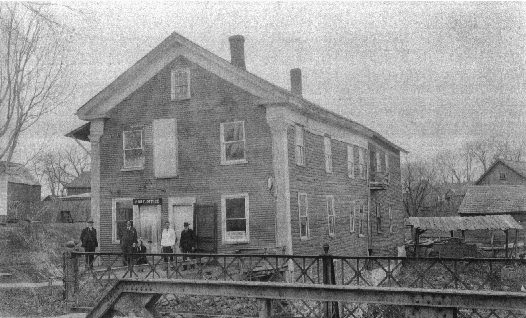
This building that used to be just below the Koch House is thought to have been the Farrar Pottery Business at one time Vermont Historical Society 


Engraving E. L. & G. W. Farrar, Pottery John Henry Walker (1831-1899)1853, 19th century
See Alfred K. Ballard Pottery Co. Collection From Marjorie P. Kohli, Waterloo, Ontario, Canada, 1999


4 gallon jug made by the W. H. Farrar & Co, with the incredible full bodied dotted rooster decor, just sold for $11,750.00 - This one was manufactured in Geddes, N.Y, not Fairfax, but by the same company that originated in Fairfax then expanded and moved to both St. John's, P.Q., Canada and Syracuse, N.Y. 


For more images Skinner Auctions 
"Early New England Potters and their Wares"
American Stoneware by William C. Ketchum, published by Henry Holt and Company, 1991

Lords of the North By James K. McDonell, Robert Bennett Campbell

Elizabeth Collard

Popular Post