Showing posts with label Merrimac River. Show all posts
Showing posts with label Merrimac River. Show all posts
Tuesday, February 21, 2017
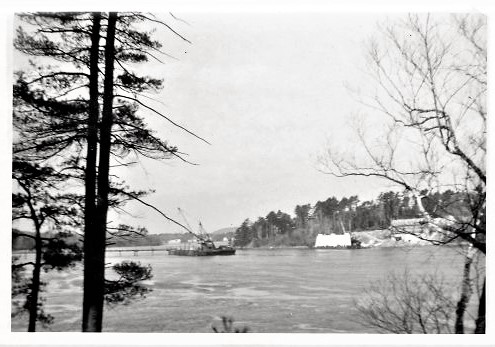
1951 building bridge across Merrimack River by Chain Bridge & Salisbury Point

Monday, December 29, 2014
‘Captain Eddie’ and the Salisbury Rum Runners

Photo courtesy of “The Salt Book” by Pam Wood
Henry Weaver, a federal
agent from Maine, busted the illegal rumrunning ring based in Salisbury.
Salisbury was one hot den for a clandestine liquor enterprise that made a notorious buzz as the “most sensational liquor trial case in the history of federal courts.”
During Prohibition smugglers transporting “white lightning” over land were known as “bootleggers” and when over water they were called “rumrunners.” No matter how the hootch got in, there was much mazuma to be made.
The Salisbury gang in 1923 had a most auspicious run. The leader, police Chief Harold Congdon, aka “Captain Eddie,” was “juiced in” and his wife was his right-hand deputy. She mapped out the drops and scheduled the runs. The remote banks of the Merrimack were an ideal area. All was wine and roses as most of the police force, selectmen and Coast Guard were in it. In fact, rumrunning became part of the community’s “official duties.”
However, human nature made a few greedy goers and the operation started to tank. Mrs. Congdon resented the fellows “drunk with power” and the rumor was she had eyes for more than the chief.
Outsiders started to cut out the band even though they were using their turf to traffic. One of them was Anthony Caramango, aka “The Jap,” who flushed them out of a big score and the horns started to lock.
Mrs. Congdon, fed up, turned to the feds, but the chief’s $1,500 fund filtered in by officer True bought him the stenographer’s court report. This seemed to “distill” the busy bodies for a brief time, but the feds were plotting a plan to teach these cowboys that a new sheriff was coming to town.
Henry Weaver, a federal agent out of Maine, busted the lot. Henry noted that “Salisbury was always a haven for bootleggers.” His boss ordered him to round up his best and make haste to Massachusetts to “catch a sheriff.” He would “deputize” them when they got to Salisbury.
The feds received tips from Mrs. Congdon to do a stakeout. The chief was there when the raid went down. He gave his crew the thumbs-up to start unloading and the agents jumped the fellows.
One of the runners from the rough Detroit crew shot agent England in the groin, but he had a bottle of gin in his pocket. Although it cut into his love log one could argue he did get lucky that night.
Over 30 incitements were brought down and there were two trials. The court was jammed with spectators. Isaac Coleman gave testimony of his sleepless nights due to the traffic from motor trucks. He swore there were “32 on the eve of Thanksgiving.” When he complained, he was told “to mind his own business” and sent off with a quart.
Several witnesses had similar stories and most went with flow. Loose lips were buttoned with a bottle. Another testified he saw “The Jap” sell a quart right at the police station in front of the chief.
Several reported piloting loads into town by orders of Congdon.
Among them were Superintendent of Streets T.O. Corliss and Selectman Howard George, both paid $25 a night. William Jackson was paid $30 for trucking the liquor but never associated with the “outlandish people.” Henry Fowler made four runs to Pierce Cottage.
William Eaton caught wind of the ring while he was duck hunting at the “break of day” along Black River Creek. While Eaton was observing the obvious illegal activities, he was approached by officer True, who promised him a private stash “over at the Blaisdell home.”
The chief was put on the wrong side of the bars, but only for a short stint. He ran a speed ring operation on Interstate 95, which ended his reign and his pension. It came to a screeching halt when he stopped a Maine couple in May 1955 who said Congdon “shook them down for $15.”
The chief and his wife ran against each for town office, but he must have still carried a flame.
He was charged with assault when he chased her and a man friend off the road with his revolver. This time he had no problem telling the judge he was all liquored up!
Thanks to Linda Dyndiuk at Robbins Library, Arlington, and Paul Colby Turner at Salisbury Historical Society. Sources for this column include the Boston Herald, Boston Associated Press, Haverhill News, The Day New London, Conn., 1977, The Northeastern Reporter, Volume 165 Commonwealth vs Congdon, Portsmouth Herald 1924, The Winchester Star; and “The Salt Book: lobstering, sea moss pudding, stone walls, rum running, maple syrup, snowshoes, and other Yankee doings” by Pamela Wood.


SALISBURY, Mass., Feb. 19 (AP) — A heated political campaign loomed here
Friday when Mrs. Sarah B. Congdon, right, estranged wife of Harold F.
Congdon, left, chairman of selectmen and police chief, announced she
would seek a place on the board. “We should be able to work together
even if we cannot live together,” Mrs. Congdon said. She recently filed
suit for divorce. Chief Congdon is a candidate for re-election.
Sunday, December 7, 2014
Newbury MA on the Merrimac thriving ship-building town
From Tuesday, August 19, 1845
Paper: Newburyport Herald (Newburyport, MA) Photo from Ghlee E. Woodworth


See more on Shipbuilding
Donald Mckay
Paper: Newburyport Herald (Newburyport, MA) Photo from Ghlee E. Woodworth

See more on Shipbuilding
Donald Mckay
Monday, August 11, 2014
Amesbury Dedicates Park To Hackett Shipyard July 22 1930

The Josiah Bartlett Chapter of the Daughters of the Revolution organization represented the home (1896-1980) when Moses Colby donated the house and property to the Bartlett Cemetery Association as a memorial to the Colby and Macy families, and to the people of Amesbury, Massachusetts. The DOR ladies compiled scrap books and from one of the treasures is this article from July 1930. Amesbury's dedication on July 22 1930 to the legendary frigate "The Alliance" forged on the banks of the Merrimac River by the Hackett family. A large scale celebration took place that included the DOR ladies hosting a reception representing another part of Amesbury's history-Quakers which inspired John Greenleaf Whittier. If you have not visited any of the landmarks in Amesbury check out Amesbury Historical Dates and Places of Interest to plan a trip.

 |
| Alliance, first continental Frigate built in Amesbury |
 |
| Alliance Park, at the confluence of the Powwow and Merrimack Rivers |
From Standard History Of Essex County Massachusetts By Cyrus Mason Tracy
William Hackett built the the frigate "Alliance," owned by the Federal government. The " Alliance ” was in the memorable battle of Paul Jones, but rendered no service, on account of the jealousy between the commanders. "She carried thirty-two guns and was the favorite of the whole navy on account of her great beauty and speed. This ship had a history. She was not only named for the alliance between this country and France, but was placed in command of a Frenchman, Capt. Landois, and her first service was to convey Lafayette to his home.” Hackett afterwards drafted and superintended the building of the frigate " Essex,” at Salem, Mass. He was the master-builder and superintendent of the twenty-gun ship “ Merrimac,” of 355 tons, which was completed in seventy-five days. The " Merrimac ” was the first and best vessel of her size furnished on loan to the government. Hackett built other vessels here for many years, and afterwards bought a place below, and built a dwelling on the site of Mr. Folsom’s new residence, and established a yard in front, and continued his business, contracting for many ships. He was also the founder of a family that has produced many eminent men. The late Prof. Horatio Hackett, known as the best Greek scholar in America, was a descendant, and native of the town.

Alliance, took on two British ships, the sloop Atlanta, and the sloop, Trespassy. From Amesbury City


More Reads:
- William Hackett, Patriot Shipbuilder of Salisbury and Amesbury, Massachusetts Beverly J. Francis Hovanec
- History of shipbuilding on North River
- Colby Family and others by Ronald Colby
- Lowell's Boat Shop Amesbury, MA
- James Hackett
- (1897)
Subscribe to:
Posts (Atom)
Popular Post
-
 From the Collection of Carolyn Hart Wood , daughter of Elizabeth Hart Marlowe Wood and Henry Wood Jr . Carolyn contacted me re...
-
 Rare Photo Collector Jeffrey Gorman, Administrator to Facebook Group New England Family Genealogy and History The Fiske/Fisk family photos...
-
 Some more examples of the furniture makers that are listed in the article below which includes links to the sources and reference materials....
-
 In 1892 John Nurse , a descendant of Rebecca Nurse who was executed for witchcraft in the Salem Witch Hysteria 1692 gave an address on t...
-
 From Peabody-Lynnfield Weekly News, October 26, 1995, p. 1 by S.M. Smoller Map From...