1903 Boston Globe Picture Hiram P Macintosh and Arthur P Huse
NEWBURYPORT’S
CUSTOM
HOUSE
WHERE
IT
COST
$5700
TO
COLLECT
$505
IN
5
YEARS Massachusetts
has
a
port
of
entry
at
Newburyport,
dignified
with
a
custom
house
and
collecting
force,
which
in
more
than
a
score
of
years
cost
the
federal
government
about
$5700
to
collect
$505
in
duties
on
imports.
Setting
well
down
on
the
lowest
bank
of
the Merrimack
River
and
almost
cut
off
from
the
business
activity
of
the
city
of
Newburyport,
stands
an
old
"stone
fort,’*
the
custom
house
of
the
Ipswich
district,
which
for
years
has
remained
as
a
monument
to
the
city’s
bygone
prosperity,
and
is
now
a
veritable
millstone
around
the
financial
throat
of
Uncle
Sam's
internal
revenue
department.
Grim,
unwashed
and
almost
forbidding
In
appearance
on
the
outside,
the
federal
building's
purpose
has
become
a
memory
of
the
past
In
the opinion
of
Newburyporters,
yet
such
is
the
system
of
Uncle
Sam’s
financial
forces
that
the
building
must
exist
as
an
institution,
so
a
collector
and
deputy
remain
in
office
to
safeguard
the
coast
against
foreign
goods
being
imported
without
official
sanction.
So
iron-bound
and
severe
are
the
regulations
of
the
Treasury
Department
that
the
life
of
the
custom
house
must
exist
even
if
but
a
box
of
Newfoundland
herring
find
entry
on
the
book
accounts
in
the
course
of
a
year.
The
utter
uselessness
of
the
custom
house
at
this
point
on
the
Massachusetts
famine,
and
the
astounding
arrival
of
800
chests
of
tea
from
an
English
port,
which
were
placed
in
bond,
and
so
materially
added
to
the
revenue.
Such
a
volume
of
business
at
the
Newburyport
custom
house
had
not
been
known
for
a
generation,
and
in
consequence
the
Treasury
Department
fell
but
a
few
hundred
dollars
behind
running
expenses
for
that
year.
From
the
time
that
the
port
of
entry
was
established
as
a
customs
district
in
1789,
with
Stephen
Cross
as
collector,
this
official
has
been
entitled
to
fees
only,
but
his
deputy
has
always
received
monthly
warrants
amounting
to
$600
a
year.
This
is
the
actual
expense
charged
against
the
duties
collected
at
the
port,
still
there
has
not
been
one
year
in
23
when
the
government
realized
a
profit
at
the
close
of
the
fiscal
year.
In
23
years
past
the
total
collections
at
the
port
have
been
less
than
$3509,
and
during
that
period
the
expense
for
a
deputy
collector
alone
has
been
$13,800,
which
gives
the
cost
of
collecting
each
dollar
at
about
$4.
Another
branch
of
the
Treasury
Department
has
been
under
a
continual
drain
during
that
time,
as
the
custodian
of
public
buildings
has
paid
out
to
Patrick
J.
Doyle
his
regular
$540
a
year
salary
as
janitor
of
the
granite
relic
of
New
bury
port's
past
greatness.
It appears
almost
farcical
to
continue
the
administration
of
such
a
treasury
depleting
institution
of
the
government.
It
is
one
which
lias
amply
proven
that
its
usefulness
has
been
outlived
and
buried
with
the
disappearance
of
the
good
old
oaken
American
“merchant
marine”
that
flew
the
flag
of
the
Union
over
waters
of
every
sea
and
ocean
in
days
of
clipper
ships
and
barks.
During
the
past
six
months,
however coast
is
shown
by
the
fact
that
during
two
schooners
from
the
provinces
loaded
the
years
of
1819, 1900
and
1901
absolutely nothing
dutiable
came
into
the
district. The
year
of
1902
was
marked
as
a
latter
day
epoch
in
the.
history
of
the
decayed
port,
as
during
this
twelve
months
slightly
more
than
$500
was
collected
in
customs
from
four
vessels
laden
with
Nova
Scotia
coal,
imported
to
relieve
the
coal
Asthma
One
of
the
hardest
tasks
in
life
is
to
combine
sentiment
with
business.
river
and
contributed
nearly
to
the
collection
credit
of
the
custom
house
at
the
mouth
of
the Merrimack.
If
this
astonishing
volume
of
business
continues
at
the
same
average
for
the
next
six
months
Uncle
Sam’s
treasury
guardians
at
Washington
may
find
an
almost
clear
1904
slate
to
he
credited
to
the
vigilance
of
Collector
Macintosh
and
his
deputy.
Inside
the
stone
fut
the
quietness
of
a. sepulcher
reigns,
except
when
an
occasional
visitor
calls
upon
the
venerable
guardian
of
Uncle
Sam’s
structure.
Scrupulous
neatness
prevails
in
the
corridors,
and
unlike
the
tomb,
a
comfortable
degree
of
heat
pervades
the
building,
all
of
which
testifies
to
the
certainty janitor
at
least
finding
the
necessity
of
earning
his
$340
a
year.
Samuel
Phillips
was
the
collector
in
1835,
and
formally
opened
the
granite
building In
1830.
It
marked
a
new
era
for
Newburyport.
The
imports
coming
to
the
mouth
of
the
river
were
characteristic
of
every
clime,
and
to
hold
the
collector’s
berth
at
that
time
was
considered
not
only
a
position
of
sinecure,
but
also
a
post
of
the
highest
honor
in
the
estimation
of
Newburyport best
citizens. (see A Customhouse for Newburyport: (1834-1835) : Architect, Robert Mills, (1781-1855)
Customs
duties
In
those
days
rarely
fell
below
$75,000 rarely,
and
often
exceeded
the
$100,000
mark,
bringing
$3000
yearly
in
fees
to
the
collector,
a
limit
which
was
established
by
law
and
still
exists.
Those
were
the
days
of
plethoric
poeketbooks
among
the
descendants
of
Newburyport’s
founders,
and
the
very
life
forces
of
the
community
existence
coursed
through
the
collector’s
offices
and
corridor
of
the
old
custom
house.
During
the
15
years
of
activity
between
1835
and
1889
Newburyport’s
Federal
building
was
the
head
and
centre
of
all
the
town's
industry.
Through
here
passed
the
sugar,
molasses,
salt,
foreign
fish
and
alcohols
that
came
in
great
bulk
from
the
Canadian
shores,
Spain,
tho
West
and
East
Indies,
while
Manila
and
the
Philippines
sent
not
a
little
hemp
for
local
rope
walks.
Then
the
Ipswich
district
was
rated
second
only
to
Boston
among
the
New
England
custom
houses
and
scores
upon
scores
of
vessels
entered
at
the
collector’s
office
weekly,
creating
an
Interest
among
the
townspeople
that
was
only rivaled
by
their
own
endeavors
toward
success.
The
history
of
the
past
generation
has
broken
away
from
the
traditions
of old
Ipswich
district,
and woefully
fallen
are
the
duties
of
the
present
day
collector.
Day
after
day with
the
most
perfect
regularity
the
aged
but
active
guardian
of
the
district
port
opens
up
his
office
for
business,
ever
hoping
for
hut
seldom
realizing
the
arrival
of
a
dutiable
cargo.
In
his
antique
furnished
private
office
at
Collector
McIntosh
passes
his
hours
between
9
and
4
o’clock
reading
the
current
news
and
occasionally
delving
into
the
musty
records
of
past
and
more
creditable
days
at
the
custom
house.
In
another
room
across
the
corridor
the
veteran
Janitor
Doyle
spends
a
few
hours
each
day
after
perfunctorily
cleaning
the
two
habitable
offices
and
corridor,
and
with
the
exception
of
daily
visits
of
a
fern*
hours
made
by
the
deputy
collector,
the
great
stone
pile
maintains
the
unearthly
silence
and
solemnity
of
an
abandoned
ship
cast
up
on
a
reef
to
remain
until
her
structure
falls
apart
of
age.
Severe
and
strict
simplicity
marks
the
disposal
of
all
the
rooms
in
the
'building,
each
one
square,
and
just
four
of
them,
dividing
the
basement,
first
and
second
floors,
while
a
generous
slice
is
taken
out
of
the
left
side
of
the
building
to
provide
for
a
stairway,
which
in
itself
is
the
most
interesting
and
unique
architectural
feature
of
the
interior.
As
shown
in
the
accompanying
cut,
the
turn
of
the
block
stone
stairway
to
the
second
floor
hall
has
the
appearance
of
needing
but
a
light
blow
to
cause
a
collapse.
Each
of
these
upper
steps,
14
inches
broad,
lap
but
a
bare
half
inch
over
the
lower
one,
and
are
apparently
held
together
with
but
a
half
inch
thickness
of
cement.
From
Collector
Macintosh's
curious
point
of
view,
he
cherishes
this
stairway
as
one
of
greatest
show
points
of
the
noted
building,
but
has
found
a
man
who explained
to
him
the
builders
secret
of
twisted
strain,
which
has
so
firmly
joined
these
blocks
of
stone
together
as
to
preclude
any
possibility
of
their
falling
in
the
lapse
of
time
already
past.
This
much
is
certain,
the
handrail
and
newel
posts
can
play
no
part
in
the
support
of
the
blocks,
and
as
but
four
or
five
inches
of
the
inner
ends
enter
tho
wall,
unless
some
great
strength
is
obtained
from
the
outer
ends
the
leverage
of
weight
would
serve
to
topple
the
steps
to
the
floor
below.
It
is
the
secret
of
twisted
strain
on
the
lapping
edges
that
has
worked
this
marvel.
In
one
of
the
basement
rooms
shown
in
the
picture
are
piled
against
the
wall
solid
brass
yards
that
served
various
methods
of
determining
weights
in
the
early
days
when
Newburyport
was
noted
as
a
most
thriving
community.
The
20-
pound
counter
balance
weights
seen
on
the
floor,
but
now
greatly
depreciated
by
rust,
were
the
silent
telltales
that
brought
floods
of
collections
to
the
coffers
of
the
collectors
of
former
days. (below 15 Water Street taken from Historic Commission Newburyport 1999)
Undisturbed
they
have
rested
against
the
walls
for
more
than
a
quarter
of
a
century
mute
witnesses
of
bygone
importations
in
days
when
the
noted
firm
of
John
Wood
&
Son
and
their
successors,
Messrs.
Sumner, Swasey
&
Currier,
and
afterwards
Sumner,
Swasey
&
Shaw,
were
the
foremost
importers
of
West
Indian
sugars,
which
were
discharged
and
weighed
at
Commercial
wharf.
Measured
buckets,
used
for
inspection
and
levying
of
duties
on
salt,
which
for
more
than
half
a
century,
with
sugar,
formed
the
bulk
of
imports
at
the
old
town,
are
to
be
seen
in
the
cut,
and
in
unloading
the
vessels
these
authorized
measures
had
to
be
used
by
the
men
discharging
cargoes.
The
fiscal
year,
which
ended
in
July,
1902.
showed
the
receipt
of
$5
import
duties,
which
cost
the
internal
revenue
department
$600
to
collect,
and
the
custodians'
department
$549
to
prepare
a
clean
floor,
heat
and
well
dusted
desk
for
the
delivery
and
recording
of
the
same.
It
is
Just
barely
possible
now
that
the
financial
receipts
in
the
old
building
may
become
rehabilitated
through
the
growing
importance
of
the boxboard
Haverhill,
12
miles
up
the
river,
to
which
point
there
are
sure
to
be
shipped
other
cargoes
of
wood
pulp
front
the
provinces
during
the
coming
spring
and
summer.
Meanwhile
Collector
Macintosh
will
follow
his
Invariable
rule
of
opening
early,
in
order
to
be
on
hand
and
ready
to
certify
to
any
unexpected
cargo
that
strays
into
port.
Since
Mr.
Macintosh
assumed
office
in
1893
his
fees
have
rarely
exceeded
$250
annually.
Still
he
is
the
responsible
head of
a
great
district
teeming
with
population,
yet
rut
off
seemingly
forever
from
the
rest
of
the
world
as
a
port
of
entry
for
foreign
goods.
Outside
on
Water
street
traffic
is
dead
at
all
times
of
the
day,
although
a
busy
square
is
but
a
quarter
of
a
mile
away from
the
custom
house.
Yet.
so
far
as
the
“fort”
is
enlivened
through
this
fact,
it
might
be
at
the
other
end
of
the
globe. Between
the
years
1850
and
1880
, when
the
greatest
volume
of
business
passed
through
the
offices
of
the
old
building,
salaries
amounting
to
nearly
$10,000
were
paid
to
residents
of
the
then
town.
Today
less
than $1200
is
received
for
the
upkeep
of
the
dignity
and
cleanliness
of
tho
custom
house.
Visit Custom House Maritime Museum
Photos not taken from Globe Article are from Cape Ann Images
“If history were taught in the form of stories, it would never be forgotten.” Rudyard Kipling.. From the Vault: Genealogy, Historical Photos, Newspaper Archives
Showing posts with label Custom House Maritime Museum. Show all posts
Tuesday, May 26, 2015
Custom House Maritime Museum Newburyport 1903 Boston Globe
Labels:
1903,
Cross,
Currier,
Custom House Maritime Museum,
Deputy Arthur Huse,
Hiram Macintosh,
Newburyport Ma,
Patrick J. Doyle,
Samuel Phillips,
Sumner,
Swasey,
Wood
Thursday, October 30, 2014
Lieutenant Adolphus Washington Greely Newburyport and Arctic Exploration
Lieutenant Adolphus Washington Greely
The Greely Expedition English Subtitled Documentary
(March 27, 1844 – October 20, 1935) Born in Newburport Massachusetts American Polar explorer, United States Army officer, Recipient of the Medal of Honor. Two articles on Greeley
Disaster at Lady Franklin Bay US Naval Institute Sailing onward article from Newburyport News Dyke Henderson
An all-day celebration including a parade, reception, and fireworks, welcomed Adolphus Greely back home to Newburyport after his Lady Franklin Bay Arctic expedition. Arches, bearing appropriate mottoes, were placed across State Street, Prospect Street, and in front of City hall. The arch at the top of State Street is shown in this photograph. Displayed on either side are the names of the two ships, Thetis and Bear, that rescued the expedition's survivors. - Courtesy photoNewburyport Daily News
78 High Street Newburyport Land bought in 1807 by Anthony Davenport and the house built soon afterward, passing in 1838 to his daughter, Mrs. Samuel T. DeFord. It remained in this family until 1871 when bought by John A. Greeley, John Balch Greely and Frances Dunn Cobb and brother to Adolphus.
From History of Essex County Volume 2 edited by Duane Hamilton Hurd
Lieutenant Adolphus Washington Greely a native of the city followed by the public reception which was accorded him. As heroic and daring as were the deeds of the sons of Newburyport during the Revolution and the War of 1842 none exceeded the exploits of this young man who illustrated by his patience his fidelity his indomitable courage in the frozen regions of the North the lines of the poet that Peace hath her victories No less renowned than war It is doubtful whether in all the trying scenes through which our country has passed of fire and battle and flood the hearts of the American people have been touched by a tenderer sympathy or a sweeter joy than the discovery of that little band heroic men of which he was the devoted leader their gallant rescue excited.
Adolphus Washington Greely was born in Newburyport March 27 1844.
His early education obtained at the public schools Though fond study and ambitious to receive a collegiate education he was precluded from his wished for career by circumstances which it was impossible for him to control and at the age of seventeen he entered as clerk jewelry store of Fairbanks & Paul in his native city and seemed likely to pursue the devious and uncertain path of a business life.
Six months later however war broke out and among the volunteers for years service he was one of the earliest to his name He enlisted as private in the Byfield Rangers who were afterwards assigned as Company B to the Nineteenth Regiment of Massachusetts Volunteers under the command of Colonel Edward W Hincks.
Having speedily reached the position orderly sergeant he felt that he was worthy of a commission He was as brave as the bravest and never thought of danger in the performance of his duty Though immersed in the surroundings of war life it is significant both of his literary taste and utter fearlessness that on one occasion when going into a battle he was more concerned about the fate a scrap cut from a newspaper laid aside to be read than about the dangers of the contest which he was about to enter.......
The Greely Expedition to the North Pole, 01 June 1822.
Naval
History & Heritage Command - Commander Winfield Schley was put in
charge of the 1884 Greely Relief Expedition, which the Secretary of the
Navy wholeheartedly embraced as an opportunity to buttress the sea
service's standing in the public eye.
Discovery Harbour, Ellesmere Island, Quttinirpaaq National Park, Nunavut, Canada, skinning a seal. [Greely Expedition Photograph]
From Greely Expedition Survivors (cabinet card photograph) contributed by: Samuel B Sharpe
SOLEMN FUNERAL SERVICES AT GOVERNOR'S ISLAND AND CYPRESS HILLS
Great Anxiety for the Explorers-Their Chances of Obtaining Provisions
Arrival of the Arctic Heroes at Portsmouth, N. H. Extremely touching meeting, after the long separation, between Lieutenant Greely and his loving wife.
The Greely Arctic Expedition as Fully Narrated by Lieut. Greely and Other Survivors: Commander Schley's Report. Wonderful Discoveries by Lieut. Greeley and His Little Band of Heroes
The Greely Arctic expedition as fully narrated by Lieut. Greely, U.S.A., and other survivors. Full account of the terrible sufferings on the ice
Chances for Arctic Survival: Greely's Expedition Revisited
Elisha Kent Kane Historical SocietyAbandoned: The Story of the Greely Arctic Expedition 1881-1884
The Biggest Chill
William Henry Whistler and the Lady Franklin Bay (Greely) Expedition, 1881-1884: Published Accounts and Transcriptions of Whistler's Writings
Ghosts of Cape Sabine: The Harrowing True Story of the Greely Expedition
CHRISTMAS IN THE ARCTIC
Fire & Ice: Adolphus W. Greely
USNS General A.W. Greely
The Adolphus W. Greely Papers
Greely Expedition BS Series
The Greely Expedition English Subtitled Documentary
(March 27, 1844 – October 20, 1935) Born in Newburport Massachusetts American Polar explorer, United States Army officer, Recipient of the Medal of Honor. Two articles on Greeley
Disaster at Lady Franklin Bay US Naval Institute Sailing onward article from Newburyport News Dyke Henderson
![]() |
| Naval History Magazine - August 2010 Volume 24, Number 4 |
An all-day celebration including a parade, reception, and fireworks, welcomed Adolphus Greely back home to Newburyport after his Lady Franklin Bay Arctic expedition. Arches, bearing appropriate mottoes, were placed across State Street, Prospect Street, and in front of City hall. The arch at the top of State Street is shown in this photograph. Displayed on either side are the names of the two ships, Thetis and Bear, that rescued the expedition's survivors. - Courtesy photoNewburyport Daily News
![]() |
| From Custom House Maritime Museum Newburyport MA |
| Prospect Street Home where Adolphus was born |
![]() |
| Alolophus with family 1887 |
78 High Street Newburyport Land bought in 1807 by Anthony Davenport and the house built soon afterward, passing in 1838 to his daughter, Mrs. Samuel T. DeFord. It remained in this family until 1871 when bought by John A. Greeley, John Balch Greely and Frances Dunn Cobb and brother to Adolphus.
From History of Essex County Volume 2 edited by Duane Hamilton Hurd
Lieutenant Adolphus Washington Greely a native of the city followed by the public reception which was accorded him. As heroic and daring as were the deeds of the sons of Newburyport during the Revolution and the War of 1842 none exceeded the exploits of this young man who illustrated by his patience his fidelity his indomitable courage in the frozen regions of the North the lines of the poet that Peace hath her victories No less renowned than war It is doubtful whether in all the trying scenes through which our country has passed of fire and battle and flood the hearts of the American people have been touched by a tenderer sympathy or a sweeter joy than the discovery of that little band heroic men of which he was the devoted leader their gallant rescue excited.
Adolphus Washington Greely was born in Newburyport March 27 1844.
His early education obtained at the public schools Though fond study and ambitious to receive a collegiate education he was precluded from his wished for career by circumstances which it was impossible for him to control and at the age of seventeen he entered as clerk jewelry store of Fairbanks & Paul in his native city and seemed likely to pursue the devious and uncertain path of a business life.
Six months later however war broke out and among the volunteers for years service he was one of the earliest to his name He enlisted as private in the Byfield Rangers who were afterwards assigned as Company B to the Nineteenth Regiment of Massachusetts Volunteers under the command of Colonel Edward W Hincks.
Having speedily reached the position orderly sergeant he felt that he was worthy of a commission He was as brave as the bravest and never thought of danger in the performance of his duty Though immersed in the surroundings of war life it is significant both of his literary taste and utter fearlessness that on one occasion when going into a battle he was more concerned about the fate a scrap cut from a newspaper laid aside to be read than about the dangers of the contest which he was about to enter.......
![]() |
![]() |
| The Crew Greely Expedition National Archives |
Discovery Harbour, Ellesmere Island, Quttinirpaaq National Park, Nunavut, Canada, skinning a seal. [Greely Expedition Photograph]
![]() |
| Lt. Edward Israel, from Greely Expedition photo, 1881. |
| |
| From James Booth Lockwood (1852 -1884) "The Greeley Arctic Exploration Exhibit, Government Building World's Fair, Chicago, USA" |
From Greely Expedition Survivors (cabinet card photograph) contributed by: Samuel B Sharpe
SOLEMN FUNERAL SERVICES AT GOVERNOR'S ISLAND AND CYPRESS HILLS
Great Anxiety for the Explorers-Their Chances of Obtaining Provisions
Arrival of the Arctic Heroes at Portsmouth, N. H. Extremely touching meeting, after the long separation, between Lieutenant Greely and his loving wife.
The Greely Arctic Expedition as Fully Narrated by Lieut. Greely and Other Survivors: Commander Schley's Report. Wonderful Discoveries by Lieut. Greeley and His Little Band of Heroes
The Greely Arctic expedition as fully narrated by Lieut. Greely, U.S.A., and other survivors. Full account of the terrible sufferings on the ice
Chances for Arctic Survival: Greely's Expedition Revisited
Elisha Kent Kane Historical SocietyAbandoned: The Story of the Greely Arctic Expedition 1881-1884
The Biggest Chill
William Henry Whistler and the Lady Franklin Bay (Greely) Expedition, 1881-1884: Published Accounts and Transcriptions of Whistler's Writings
Ghosts of Cape Sabine: The Harrowing True Story of the Greely Expedition
CHRISTMAS IN THE ARCTIC
Fire & Ice: Adolphus W. Greely
USNS General A.W. Greely
The Adolphus W. Greely Papers
Greely Expedition BS Series
Labels:
Adolphus Washington Greely,
Arctic Explorations,
Custom House Maritime Museum,
Elison,
Greely Expedition,
Israel,
Lady Franklin Bay,
Lockwood,
Newburport News,
Newburyport Ma,
Pavy,
PBS,
Schley
Thursday, October 16, 2014
The Unveiling of the USS Keararge Captain's Cabin Desk John J. McAleer, III Speech
A Big Thanks to John and Andy McAleer for sharing this. I met them in Salem Ma last Spring and they were so gracious and generous to share their family history with me and all the treasure trove of these great heroes and their descendents. See also the first blog share I posted last Spring Austn Quinby & USS Kearsarge John J. McAleer, III Union League Club Philadelphia 23 July 2014
In May John and his brother Andy went to Philadelphia to donate a desk from the Kearsarge Society that was in Captain Winslow's ship cabin. They went down again in July to formally donate it. This is a copy of John's speech in front of Admiral Lynch (former head of Annapolis ) and Lt. Colonel Ralph Peters.
The story below is from George Costopulos Auctioneers located at 9 Cerqua St.Woburn, MA 01801 Andrew McAleer & John J McAleer the lll are two gents who currently live in Lexington ma. They come from a long military family history, their great grandfather John J. McAleer served on the USS Kearsarge as an orderly to Captain Winslow. He also kept the log book of the Kearsarge for it's 34- month cruise. He wrote the log on Captain Winslow desk. The same desk that was present in the Captain quarters during the battle with the Alabama on June 11, 1864. (As a side note this June 11th 2014 will be the 150 anniversary of this important battle.) This was the story they always heard growing up and took great pride in having this historic desk.
John J. McAleer lll inherited the desk from his dad John J McAleer ll who acquired the desk in 1925 from his uncle Billy, John William McAleer, who was the oldest son of John J. McAleer, orderly to Captain Winslow. In the desk there has for the last ninety year a letter that stated "This desk came from the Captain’s cabin of the Civil War Craft Kearsarge. It was bought at the auction of some of her (Kearsarge) fittings on the return to Boston, after the fight with the Alabama, by the father of T. Julian (sic) Silsby, 50 Congress Street Boston and later given to John Dixwell MD 52 Cedar St Boston and by him June 16, 1925 given to Wm. McAleer of Fairfield St Cambridge Mass." This is the story that the two brothers had heard growing up and there was much fact to back this story. They had the oral history along with photos, medals and paper documents to back this story up. But how did the desk get to uncle Billy and who was Dr. Dixwell, T. Julian Silby and the father of T. Julian Silby who are mentioned in the letter.
The Kearsarge, after the battle with the Alabama and other duties, cruised into Boston harbor at one o'clock in the morning on November 8th for much needed repairs. Thousands of New Englanders turned out for the Kearsarge home coming. After all the Kearsarge was named after New Hampshire's Mt Kearsarge and the ship was built from the timber surrounding Mt. Kearsarge and her crew were mostly New Englanders. The ship was temporarily decommissioned for repairs. The questioned remained, were T. Julian Silby, his father and Dr Dixwell real historical figures? It turns out after much research that T. Julien Silsby and Father Thomas J. Silsby owned a cordage company in South Boston, (Thomas J. Silsby & Son) who did this kind of ship repair work. It stands to reason that father Silsby could have acquired the desk at an auction of the Kearsarge fittings and passed it to his son T. Julian Silby, who according to the letter passed it on or sold the desk to Dr. Dixwell. Is Dr Dixwell a real historical figure? It turn out that he is real and held a prominent position in Boston & Kearsarge history. After the veterans of the Kearsarge were finished with their service the survivors gathered for many reunions and enjoyed accolades from across New England. They were treated as heroes for man, many years. John J. McAleer was very active in serving the veterans & survivors of the Kearsarge . He served as president & secretary to these meeting until his passing. His son John William McAleer “Uncle Bill” in the 1920s served as Secretary of Kearsarge Naval Veterans Association (“KNVA”) and attended annual Kearsarge Survivor meetings documenting dates and attendees.He lived at 26 Fairfield Street in Cambridge, Massachusetts with nephew John J. McAleer, II. In addition, he was a friend and colleague of John Dixwell, MD in the KNVA. Dr. John Dixwell was a Boston Surgeon born in Cambridge, Massachusetts on March 21, 1844. A graduate of the Latin School, Harvard, and Harvard Medical School, Dr. Dixwell served as a President and Surgeon of the Kearsarge Naval Veterans Association, member of Post No. 13, G.A.R., and G.A.R. Club of Massachusetts. He frequently appeared in Boston newspapers concerning his work with the Kearsarge and her survivors. This is the connection between William McAleer (Uncle Billy) and Dr Dixwell. As the provenance letter states, Dr. Dixwell gave the desk to “Wm McAleer Fairfield Street, Cambridge, Mass on June 16, 1925.” Three days before the 61st anniversary of the great battle. William McAleer in turn gave the desk to John J. McAleer, II, who in turn gave it to John J. McAleer, III.
Along with The Kearsarge desk all the reunion Photos with all the names on the back for identification and the letter of succession to the present owner and a few others provided by private families I have included
John A. Winslow (3d from left) and officers on board the U.S.S. Kearsarge after sinking the C.S.S. Alabama, 1864.
USS Kearsarge (1862-1894)
"Survivors of the U.S.S. Kearsarge" -- Veterans of the Kearsarge's Civil War crew at a reunion, circa the 1890s. Those present are identified (as numbered) as:
1. Austin Quinby; 2. John Young; 3. Charles A. Poole; 4. William B. Poole ("was QM - at the Con June 19, 1864", during the battle with CSS Alabama. Awarded the Medal of Honor); 5. Joel Sanborn; 6. George Remick; 7. John F. Bickford (Awarded the Medal of Honor); 8. Adoniram Littlefield; 9. William Badlam (2nd Assistant Engineer in 1864); 10. Martin Hoyt; 11. Andrew J. Rowley;
12. John T. Stackpole;13. Patrick McKeever; 14. Lyman P. Spinney; 15. William Wainwright; 16. Lawrence T. Crowley; 17. True W. Priest; 18. J.O. Stone; and 19. John C. Woodberry. "The unmarked are not veterans." U.S. Naval Historical Center Photograph.
See also Newburyport and the Civil War by William Hallett Bill Hallett and his wife Elizabeth, host “Footsteps of Heroes: Civil War Walking Tours of Newburyport” and are actively involved in the Civil War Roundtable.
To order book contact Bill Hallett Also in Newburyport visit Custom House Maritime Museum
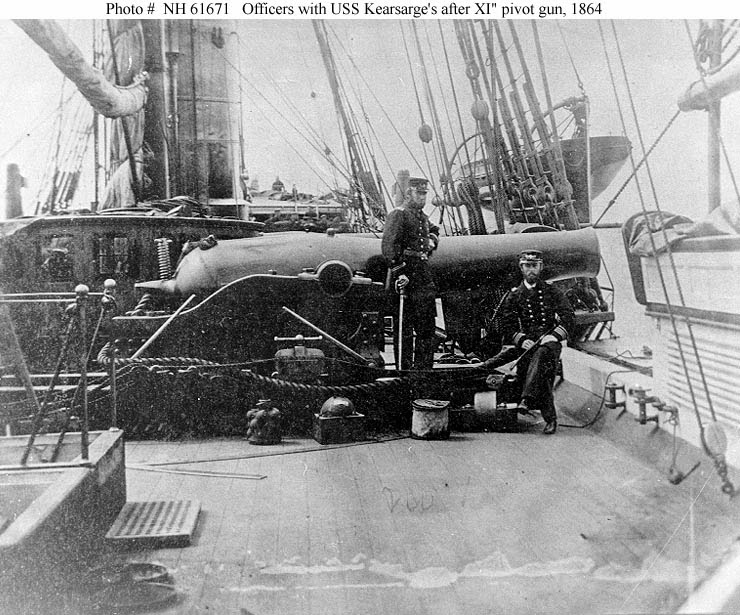
Acting Master Eben M. Stoddard (left) and Chief Engineer William H. Cushman.
From Article Boston Globe by Virginia Bohlin
Antiques & Collectibles: Relics of war and musical instruments
In May John and his brother Andy went to Philadelphia to donate a desk from the Kearsarge Society that was in Captain Winslow's ship cabin. They went down again in July to formally donate it. This is a copy of John's speech in front of Admiral Lynch (former head of Annapolis ) and Lt. Colonel Ralph Peters.
On the Ocassion of the Unveiling of the USS Kearsarge's Captain's
Cabin Desk
It is hard to believe, but thirty years ago this summer I was training to become a United States Marine down at Paris Island. My father wrote me at the time and told of how President Reagan was going to Mainland China. The press pulled Secretary of State George Shultz aside and asked if this was the first time the President has visited a Communist country?
History is all around us. I hope this desk and its history
will be enjoyed by future generations.
It is hard to believe, but thirty years ago this summer I was training to become a United States Marine down at Paris Island. My father wrote me at the time and told of how President Reagan was going to Mainland China. The press pulled Secretary of State George Shultz aside and asked if this was the first time the President has visited a Communist country?
Without hesitation the Secretary responded, " Well he has been
to Massachusetts ".
If the truth be told, Massachusetts and New England played a
major part in the events that lead up to the Civil War. The Abolitionist
movement; Harriet Beecher Stowe's novel Uncle Tom's
Cabin ; John Brown did much of his fund rising throughout
New England ( Ralph Waldo Emerson was an early supporter but became
disillusioned with Brown after Harper's Ferry ); Daniel Webster was instrumental
in the passing of the Missouri Compromise.
Other events such as the Dred Scott decision;
Bloody Kansas; and the Lincoln/Douglas debate helped ignite the inevitable.
In New England the navy warships were built. The USS Kearsarge
was named after Mt. Kearsarge in New Hampshire that supplied the timber for her
existence. It was launched from the naval shipyard in Portsmouth, New
Hampshire.
The south converted cargo ships into raiders, however the CSS
Alabama and CSS Florida were purchased in England under the guise of being
merchant ships.
This past Monday was the 153rd
anniversary of the first battle of "Bull Run". July 3rd
marked the 151st anniversary of the northern victories at
both Gettysburg and Vicksburg. Two weeks shy of a year later the USS Kearsarge
and CSS Alabama faced off each other outside the port of Cherbourg, France. By
then the international community recognized the Confederacy was losing its fight
for independence.
It is believed that Captain Raphael Semmes, in command of the
CSS Alabama, felt a victory over the USS Kearsarge would lift Southern Morale.
Of the three major naval battles of the Civil War this was the most
exciting.
On January 11, 1863 the CSS Alabama defeated an inferior ship,
the USS Hatteras in the Gulf of Mexico. Ironically Captain Semmes accused the
USS Keararge of cheating because it used chain armor alongside the ship's
exterior. However 2nd Lt Arthur Sinclair, of the CSS
Alabama, said Captain Semmes was well aware of this fact before the battle.
If the truth be told Captain John Winslow, of the USS
Kearsarge, had a well trained and disciplined crew. The Alabama was made up of
sailors from around the world. It fired many shots at the Kearsarge, but it was
clear that the quality of the shells were effected from the storage in between
the engine room and the water distiller, causing the magazines to be ruined by
humidity.
After the battle Semmes and fourteen officers from the Alabama
escaped on the British yacht
" Deerhound ", including R. K. Howell, the brother-in-law of
Jefferson Davis.
To have had a family member witness this moment has always
been a source of pride for my father, brothers and myself. When my brother
Andrew and I visited in May we walked around " Independence Hall ". There was a group of retired men
walking around with their wives wearing 402nd Tanker
Division hats. It was clear they were proud of their military service, and it
was even more clear talking to them that their enlistment helped shape their
character and make them the men they became.
The next day Andrew and I went to Lancaster county and stopped
into a store named after President Lincoln's secretary, John Hay, who later
served as Secretary of State for both President McKinley and Roosevelt. On the
way out we talked to a man wearing a Navy Sea Bee's hat. He served as an officer
for twenty years. When I mentioned that Andrew served in Afghanistan as a combat
historian, his face lit up and he said, " My dad was a photographer during World
War II and was responsible for taking the pictures at Nagasaki ".
The story below is from George Costopulos Auctioneers located at 9 Cerqua St.Woburn, MA 01801 Andrew McAleer & John J McAleer the lll are two gents who currently live in Lexington ma. They come from a long military family history, their great grandfather John J. McAleer served on the USS Kearsarge as an orderly to Captain Winslow. He also kept the log book of the Kearsarge for it's 34- month cruise. He wrote the log on Captain Winslow desk. The same desk that was present in the Captain quarters during the battle with the Alabama on June 11, 1864. (As a side note this June 11th 2014 will be the 150 anniversary of this important battle.) This was the story they always heard growing up and took great pride in having this historic desk.
![]() |
| Hand Colored & pained picture of John J. Mcaleer around 1863 |
![]() |
| Civil War cased tintype of a McAleer relative |
![]() |
| John McAleer outside old homestead in Salem Ma Quinby home |
Along with The Kearsarge desk all the reunion Photos with all the names on the back for identification and the letter of succession to the present owner and a few others provided by private families I have included
![]() |
| John C. Hayes Coxswain U.S.S. Kearsarge |
John A. Winslow (3d from left) and officers on board the U.S.S. Kearsarge after sinking the C.S.S. Alabama, 1864.
USS Kearsarge (1862-1894)
"Survivors of the U.S.S. Kearsarge" -- Veterans of the Kearsarge's Civil War crew at a reunion, circa the 1890s. Those present are identified (as numbered) as:
1. Austin Quinby; 2. John Young; 3. Charles A. Poole; 4. William B. Poole ("was QM - at the Con June 19, 1864", during the battle with CSS Alabama. Awarded the Medal of Honor); 5. Joel Sanborn; 6. George Remick; 7. John F. Bickford (Awarded the Medal of Honor); 8. Adoniram Littlefield; 9. William Badlam (2nd Assistant Engineer in 1864); 10. Martin Hoyt; 11. Andrew J. Rowley;
12. John T. Stackpole;13. Patrick McKeever; 14. Lyman P. Spinney; 15. William Wainwright; 16. Lawrence T. Crowley; 17. True W. Priest; 18. J.O. Stone; and 19. John C. Woodberry. "The unmarked are not veterans." U.S. Naval Historical Center Photograph.
See also Newburyport and the Civil War by William Hallett Bill Hallett and his wife Elizabeth, host “Footsteps of Heroes: Civil War Walking Tours of Newburyport” and are actively involved in the Civil War Roundtable.
To order book contact Bill Hallett Also in Newburyport visit Custom House Maritime Museum
Acting Master Eben M. Stoddard (left) and Chief Engineer William H. Cushman.
From Article Boston Globe by Virginia Bohlin
Antiques & Collectibles: Relics of war and musical instruments
The Civil War relic is the desk from the
captain’s cabin of the famed USS Kearsarge that will be offered at the
George Costopulos estates auction next Sunday at 2 p.m. at Sons of Italy
Hall, 168 Lexington St., Woburn.
The
201-foot steam and sail sloop, which was built in 1861 at the Portsmouth
(N.H.) Navy Yard and named for New Hampshire’s Mount Kearsarge, became
famous when in a one-hour and 20-minute battle on June 19, 1864, off the
coast at Cherbourg, France, it sank the Alabama, the most successful
Confederate raider of the war.
The desk has been consigned by John J.
McAleer III of Lexington, whose great-grandfather Private John J.
McAleer of Cambridge served as orderly to the Kearsarge’s commander,
Captain John A. Winslow (1811-73) of Boston. Winslow, who retired from
the Navy as a rear admiral, is buried at Forest Hills Cemetery with a
boulder from Mount Kearsarge at the head of his grave.
The
desk was given in the 1990s to the consignor by his father, John J.
McAleer II (1923-2003) of Cambridge, a professor at Harvard and Boston
colleges for more than a half-century, who had been given the desk in
the 1940s by his uncle John William McAleer, the eldest son of Private
McAleer.
A letter of provenance is included,
written on June 26, 1925, noting that the desk was purchased by Thomas
J. Silsby, a Boston manufacturer of cordage machinery, at an auction of
Kearsarge fittings when the ship returned to Boston in November 1864 for
repairs.
The desk was later acquired by
Dr. John Dixwell, a Boston surgeon, who served as president of the
Kearsarge Naval Veterans Association, and who in 1925 gave the desk to
the association’s secretary John William McAleer.
The desk will be sold with documents, photographs, Kearsarge fittings, and other Kearsage memorabilia.
For more information, go to www.georgecoestatesales.com.
THOMAS J. SILSBY & SON, as recorded in Commerce, Manufactures & Resources of Boston, Mass: A Historical, Statistical & Descriptive Review
Manufacturers Of Cordage Machinery, Broadway Bridge, South Boston. Of those industries which bear an important part in the growth and prosperity of Boston, that conducted by Messrs. Thomas J. Silsby &: Son may be regarded as a prominent one. This house was established in 1854 by Messrs. Moore & Wood worth, who were succeeded .by Isaac B. Rich, and he, in turn, by Silsby &
Cheney, who conducted the business for fifteen years previous to 1880,
when the present firm became proprietors of the plant. Since the
accession of the senior member of the firm to the head of this house,
its business has been largely increased, and its influence for good
extended throughout a w ide territory. Being an expert and practical mechanic, Mr. Silsby devoted
himself with ardor to the production of machinery which should be equal
at least to any made either at home or abn ad, and vie in excellence
with all. That his firm succeeded in this object is no matter of doubt;
and the excellence they attained in the production of their specialties
was such as to have created a demand from the nearest, as well as the
most remote points of the United States, Canadas, Great Britain, and
other foreign countries.The plant of this house occupies a floorage area
of about 12,000 square feet. Thirty operathes, exerts in the manufacture
of machinery, are engaged ere; while the machinery and tools in use are
of the latest improved designs. The principal products of this house, and those
for which it has become so widely celebrated, are for the manufacture of
Coticn, Hemp, and Manila Rope, and for the preparation of the raw
materials used in the manufacture. This machinery is in many respects
novel, ingenious, ar.d unique: and some of it is made by them only. It
includes Woodworth's Patent Rope Laying and Banding Machines, John
Good's Patent Spreaders, for preparing hemp, flax, and manila;
Drawing-Fratr.es, Spinning-Jennies, Forming and Laying Machines. The
Rope-laying Machines made here are the onlv ones made in this country.
As before remarked, the workmanship of these products may be implicitly
relied on. They are strongly made, are durable, and work with the
tiimost precision. The firm also manufacture and supply new and
improved Pistons and Packing for Steam-Kngines, Pumps, etc., and make a
specialty of boring steamcylinders and Corliss valve-seats, without
removal from the bed-plates. The individual members of the firm are
Messrs. Thomas J. Silsby and T. Julien Silsby, both
of whom may be said, through their house, to be thoroughly identified
with the advancement of the industrial rmerests of Boston.
The standing of this house is so well known as to
need no commendation at our hands: suffice it to say, that, in a career
extending over so long a period, it has maintained a reputation of
which its proprietors may justly feel proud, and for which it is
entitled to the highest esteem and consideration.
Labels:
Captain Cabin Desk,
Cheney,
Civil War,
Cushman,
Custom House Maritime Museum,
Dixwell,
Hallet,
Hayes,
Hobson,
Houghton,
John McAleer,
Newburyort MA,
Quimby,
Remick,
Rich,
Silby,
Stoddard,
USS Kearsarge,
Winslow
Subscribe to:
Posts (Atom)
Popular Post
-
From the Collection of Carolyn Hart Wood , daughter of Elizabeth Hart Marlowe Wood and Henry Wood Jr . Carolyn contacted me re...
-
Rare Photo Collector Jeffrey Gorman, Administrator to Facebook Group New England Family Genealogy and History The Fiske/Fisk family photos...
-
Some more examples of the furniture makers that are listed in the article below which includes links to the sources and reference materials....
-
In 1892 John Nurse , a descendant of Rebecca Nurse who was executed for witchcraft in the Salem Witch Hysteria 1692 gave an address on t...
-
From Peabody-Lynnfield Weekly News, October 26, 1995, p. 1 by S.M. Smoller Map From...