Showing posts with label Caldwell. Show all posts

Friday, March 14, 2014

George Peabody roots of success started in Newburyport


George Peabody was an American-British entrepreneur and philanthropist who founded the Peabody Trust in Britain and the Peabody Institute and George Peabody Library in Baltimore, and was responsible for many other charitable initiatives.  
History of Essex County, Massachusetts: With Biographical Sketches of Many of Its Pioneers and Prominent Men, Volume 2 George Peabody, of London began his business career in Newburyport. He was born February 18, 1795, in that part of Danvers which in 1855 was incorporated as South Danvers and in 1868 named Peabody. He there received his early education, and in 1811, at the age of sixteen, left school and entered as clerk the store of his uncle, David Peabody, in Newburyport. His companions there in social life were Charles Storey, Abner Caldwell and Francis B. Somerby, and it was on the evening of the last of May, 1811, that these young men started for home from Hart’s tavern, where they had been bowling, and young Peabody, leaving Storey and Caldwell near the foot of Kent Street and Somerby at Market Street, proceeded on alone. On reaching Inn Street he saw flames bursting out from Lawrence’s stable and gave the alarm. This was the beginning of the great fire, as it is always called, which swept over sixteen and a. half acres of the most compactly built and the busiest part of the town. More than two hundred buildings were consumed between half-past nine o’clock in the evening and sunrise the next morning. Nearly all the shops for the sale of dry-goods, four printing-ofiices, the custom-house, the post-oilice, two insurance ofiices, four book-stores, one meeting-house and a hundred dwellings were consumed, and suffering and privation ensued which the warm-hearted liberality of Boston and other towns only partially alleviated.
From Mr. Peabody at the Essex County Fair
Date: Saturday, October 4, 1856
Paper: Daily Atlas (Boston, MA) Volume: XXV Issue: 81 Page: 2


Mr. Peabody remained with his uncle until some time after the fire, when he made arrangements to go into business in Baltimore. So well had he performed his duties as clerk, that he obtained from his uncle and Prescott Spalding and others a joint letter to James Reed, a large wholesale dry-goods dealer in Boston, offering to be security for Peabody in the aggregate sum of $2500 for goods which Mr. Reed might furnish to establish his store. The signers of the letter were all customers of Mr. Reed, who believing that he could trust the person in whom they put their faith, told him that $2500 would be rather a small amount to start a dry-goods store in Baltimore, and offered him goods to the amount of $2500 more to sell on commission for him, so that not only did Mr. Peabody learn his first business lessons in Newburyport, but to the merchants of that town he owed also that timely aid without which that career of prosperity and wealth upon which he afterwards entered may never have been begun.

Not long after he became a partner of Elisha Riggs in the dry-goods trade in New York, and afterwards ‘ again in Baltimore. During all this period he made occasional visits to Newburyport, and always remembered with pleasure his old friends in that town. A writer in the Newburyport Herald remembers hearing Frank Somerby on a morning in the summer of 1826 shout to Spalding, “ Here comes George Peabody.” “I looked,” says the writer, “and saw coming down the street a tall, fresh-looking, well-dressed man of about thirty years of age. He was swinging his right arm and shouting, ‘Hello! Frank.’ In a few moments there were a. dozen old friends gathered about him, and the warmth of the greeting gave ample evidence of the estimation in which he was held." This was his first visit to Newburyport since he left it twelve or thirteen years before.


In 1843, Riggs and Peabody separated, and their business, which had expanded and largely changed its character, was divided. Riggs took the Baltimore business, Peabody the London and Mr. Corcoran, who had been some time also a partner, took the Washington. His career in London is too well known to be restated. Out of his abundant wealth, without waiting for that separation from his riches which death must eventually cause, he preferred the bestowment of benefactions during his life. In 1852 he gave to his native town $20,000 for the foundation of an institute, and afterwards increased the amount to $200,000. He contributed $10,000 to the first Grinnell Arctic Expedition, and in 1857 gave $300,000 to found an institute of science, literature and the fine arts in Baltimore, afterwards increasing it to $1,400,000. For the benefit of the poor of London he gave in 1862 £500,000, in recognition of which the Queen presented him with her portrait, and the city of London presented him with the freedom of the city in a gold box, and after his death the citizens erected a statue to his memory. In 1866 he gave to Harvard College $150,000 to establish a museum and professorship of American Archaeology and Ethnology, and afterwards $150,000 to found a geological professorship in Yale College, and $2,000,000 to the Southern Educational Fund.

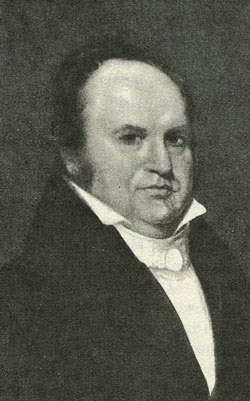
On the 20th of February, 1867, two years before his death, he gave to “ Edward Mosely, Caleb Cushing, Henry C. Perkins, Eben F. Stone and Joshua Hale, and their successors, the sum of $15,000 to be held by them in trust and kept permanently invested, and the income thereof used and applied in their discretion to the enlargement of the public library of the city of Newburyport."

Ebenezer Moseley From Clipper Heritage Trail

Moses Davenport
During the mayoralty of Moses Davenport he again visited Newburyport and-was introduced by him to the people. Among the crowd was a gray-haired veteran who, on taking him by the hand, said : “You do not remember me, Mr. Peabody." He at once replied : “You are Prescott Spaulding, and were a clerk in the store next to ours at the time of the fire in 1811, which drove me away from this good old town.” An old lady said: “Let me shake hands with you, Mr. Peabody ; you do not certainly remember me.” “Yes, I do,” said be, after a moment; “ I think you are Rebecca Tracy, and I am glad to see you. We will not tell these gentlemen about our playing whist forty years ago.”

Mr. Peabody was said to have had a love-affair in Newburyport, and it was further said that the father of the lady said: “ George is a very good young man, but he has no money and can never support you in the style you must live in." He died in London, November 4, l869.

Read a great tidbit about Peabody paying his tab at a tavern in Concord NH 


From  Monday, July 28, 1851 Paper: Salem Register (Salem, MA) Page: 2


 Dedication of the Danvers Archival Center at Memorial Hall, Spring of 1973.

From  Wednesday, January 7, 1857 Paper: Boston Evening Transcript (Boston, MA)


Sunday, February 9, 2014

Some Old Inns of Newburyport

Boston Gazette Monday January 2 1771
"William Lambert, from Yorkshire in England, begs Leave to inform the Publick that he has taken the Inn at Newburyort, formerly occupied by Mr. Choate, which is now completely repaired, and new furnished with convenient Furniture, and the greatest variety of excellent LIQUORS. He has also provided commodious Stabling for Horses and every Accommodation for Travellers and others. He humbly intreats Custom and will strive by his good Entertainment to merit the Publick Favour, at the Sign of the Wentworth Arms, near the Ferry, in Newburyport.


Six months later we find that Robert Calder (Pic above) from London, who writes himself down as " late servant to his excellency Governor Wentworth," has purchased William Lambert's lease and offers, in addition to the attractions of his predecessor's advertisement "best Entertainement with diligent attendance." Not for nothing had he bent to the imperious will of Governor Wentworth, it would appear.

Major Ezra Lunt was another of the late eighteenth century innkeepers in Newbury, adding the calling of publican quite easily to that of publisher, stagecoach proprietor and veteran of the Continental army. His inn was on the northwesterly side of Federal street, near the corner of Water street.

The splurge par excellence in the innkeeping way was made, however, by the enterprising landlord who advertised at the SIGN OF THE AMERICAN EAGLE in the summer of 1799. Under this patriotic headline "Samuel Richardson Informs his friends and the public in general that he has removed from Union Hall into that spacious and convenient building lately occupied by Captain Ebenezer Stocker, East Corner of the Ferryway Wharf, — which he has opened for public Entertainment and will make every exertion to gratify and please those who may visit his House. Every favor will be gratefully acknowledged, Good accommodation for a few Boarders: likewise Stabling for Horses."


It is interesting in this connection to note that the Newburyport selectmen had fixed by law the price of these various items of service. So, because the landlords could not underbid in price they overbade in attractions. The law placed "Dinners at taverns, for I travellers, of boiled or roast meat, with other articles equivalent, exclusive of wine at 1/16. Supper and breakfast 1/ each. Lodging 4/. Keeping a horse for one night, or for twenty-four hours, with English hay 2/—."

The Tracy house, which had accommodated Washington, became briefly the Sun Hotel, early in the eighteenth century, its proprietor, Jacob Coburn, informing the public (May 5, 1807), under a sign which quite effectively reflected the features of Old Sol, " that he has opened a spacious HOTEL in State street, Newburyport, the former mansion of the late Honorable Nathaniel Tracy Esq., and where Mr. James Prince last resided. Having at considerable pains and expense put the above in a situation suited to accommodate gentlemen he assures them with confidence that they will find every convenience and an unremitting attention to ensure the favor of the Traveller. Good horses and carriages to be had at all hours."  ad on L from Currier Old Newburyport


The dwelling-house of the eccentric "Lord" Timothy Dexter also descended temporarily to tavern uses, heralded by the following genial announcement: "The subscriber of Weare N. H. acquaints the public that he has taken the noted house on High Street, Newburyport, known by the name of Dexter House (where the Lion and the Lamb lie down together in peace and where the first characters in the land are known to make their stay) which he opened on the 20th ult. as a house of Entertainment for the weary traveller who may sojourn thither, and for the conviviality of the jovial citizens of the town who may wish to spend a social hour freed from the cares of busy life; and he respectfully solicits their company, fully persuaded that he shall be enabled to afford them satisfaction. Country people are informed that he will entertain them as reasonably and with as good cheer, both for man and beast, as any regular Innkeeper between M'Gregor's Bridge and Newburyport, having commodious and convenient stables with good attendance. He flatters himself they will call and see William Caldwell." This advertisement might have been written yesterday, so modern is its tone and so little archaic its spelling. Yet its date is April, 1810.


Prince Stetson, formerly of the Wolfe Tavern, returned to Newburyport in 1823 and assumed charge of the Washington hotel on the corner of State and Temple streets. He had the honor of serving Lafayette when the Marquis visited the town in 1824, and took the spacious apartments in the Tracy house which Washington had occupied during his visit in 1789. The landlord's son, Charles, then a lad of thirteen, had the honor of acting as valet de chambre to the liberty-lover who had done so much for America in her hour of need. From Newburyport Herald  May 31 1825

A tavern which is constantly mentioned in John Quincy Adams's account of his young manhood days in Newburyport is Sawyer's on the Bradford road at or near Brown's springs, and within the present limits of the town of West Newbury.


Picture by Southworth & Hawes

One interesting entry in the diary of this law student is that of May 21, 1788. "I walked," he says, "with Pickman in the evening to Sawyer's where we drank tea and made it almost ten o'clock before we got home. I then went up with my flute to Stacy's lodgings, our general headquarters. About a quarter before twelve Stacy, Thompson, Putnam with a couple of young lads by the name of Greenough and myself sallied forth upon a scheme of serenading. We paraded round town till almost four in the morning."


The charming home of Mrs. Harriett Prescott Spofford, near Newburyport's picturesque chain bridge, was once a tavern, also. It was then close to the public highway and its landlord, Ebenezer Pearson, was therefore not exempt from suspicion when Major Elijah P. Goodridge of Bangor, Maine, told, December 19, 1816, of having been assaulted about nine o'clock the previous evening, very near its doors, and robbed of a large sum of money. From Miner Descent


Pearson proved to be only one of the many who were subsequently accused, however, and, when Daniel Webster took the matter in hand he made Goodridge so contradict himself on the witness-stand that verdicts of " not guilty" were brought in for all the defendants. The whole thing appears to have emanated from the brain of the Major who, in order to escape financial trouble and at the same time account for the loss of his personal property, devised the scheme of a robbery and carried it into effect, firing with his own hand the pistol of the "assailant." Picture below Harriet  P  Spofford


One Newburyport tavern-keeper was a good deal more permanently embarrassed by the cleverness of one of his guests, as we shall see from the following papers on file at the State House in Boston and having to do with the escape of Bridget Phillips, who had been sent to Newburyport for safe keeping during the siege of Boston: "To the Honorable Provincial Congress at Watertown, June 22, 1775
"The petition of Bridget Philips humbly showeth that she hath lately arrived from Ireland and is desirous of going to her husband now in Boston. She therefore prays the Honorable Congress that they would give her a permit to go into the town of Boston & your petitioners as in duty bound will ever pray. BRIDGET PHILIPS."


In answer to this petition the following resolution was adopted June 24, 1775: — "Resolved, that General Ward do not suffer or permit Bridget Phillips, wife to an officer under General Gage, to go into Boston, nor any other person whatever, without leave first obtained of this Congress, or some future house of representatives; and that an express be forthwith sent to the committee of safety for the town of Newburyport, to order them to take the most affectual measures to prevent the said Bridget from going out of this province, or to Boston." The lady got the better of the law-makers, however, as the following letter shows: —"Newburyport, 26th July, 1775. "Sir: —
"We received some time since a Resolve of the late Congress ordering that Bridget Phillips (who called herself the wife of a Captain Phillips in Gen. Gage's Army) should not leave the Province & that the Committee here be desired to attend to her. Upon the receipt of it we applied to the Tavern Keeper, at whose house she was, to keep an eye upon her movements & to inform us should she take any suspicious steps, at the same time informing her that she must not leave the Province. This she judged to be very harsh but appeared for a month past so to acquiesce in it as to elude any suspicion in us that she would take pains for her escape. Upon the arrival of the New General at Cambridge she seemed to flatter herself, her case might be more tenderly considered by them & that upon application they would permit her to go to her husband. This she mentioned to several of the committee but was told she must not go to Cambridge without consent of a majority of them. However that she never asked & the 18th Inst, she took place in a Chaise with Capt. John Blake (formerly of Boston) from hence to Salem, giving out that she was going to Head Quarters at Cambridge. The Tavern Keeper (Mr. Greenleaf) supposing it not beyond the limits by the Order & from a faulty Inattention never gave the Committee notice. It was not for a day or two known by us that she was gone. Upon enquiry we find that she hired a Chaise & Boy at Salem & in company with Benjamin Jenks (who is said to belong to Casco Bay) she went the next day to Haverhill & the next to Portsmouth & by the assistance of this Jenks procured herself to be put on board the Scarborough Man of War there. This Intelligence was bro't us by the said Mr. Greenleaf whom we sent in pursuit of her.
"As she was a Woman & appeared of Some Fashion we did not think it expedient to put her under close Confinement neither did we suppose by the Order it was intended.
She left here two Trunks supposed to contain valuable apparrell which might prevent in Mr. Greenleaf the apprehention of her intending to go off. We judged it proper to give you this information & as she wrote for her Trunks to be sent to Boston we beg your Order about the delivery of 'em. Upon this occasion give us leave to remark what we hinted formerly to the Committee of War at Cambridge the ease with which an escape may at any time be made to the stationed ship at Portsmh as things are now ordered. We are respectfully


"Your obedt servnts "JONA. TITCOMB. "p. order of the Committee. "To the Honb. James Warren, Esq., (pic above) speaker of the House of Representatives, to be communicated."

The result of all this was that, though Bridget did not get her trunks, Landlord Greenleaf was made pretty uncomfortable,— and what was of far greater importance,— the seaport towns were given leave to do whatever might seem to them wise in the way of preventing other such escapes.

The privileges of tavern-keeping were so great that often a man with every right to whatever his house might earn was made exceedingly uncomfortable by his rivals. Such was the case with the host of the Boynton Tavern on the road between Newburyport and Rowley. In March, 1811, the other landlords of Byfield protested against Boynton's tavern, stating that while it had been established for some time they doubted whether its continued existence was necessary. "The influence of this tavern is pernicious to the morals, the peace and comfort of some families in the vicinity," declares the protest; after which it goes on to allege that " the undersigned are credibly informed that people are there at very unreasonable hours in the night" and that " even the holy Sabbath is profaned by persons who there pass the Sacred hours in an idle and dissolute manner." Whereupon the petitioners humbly prayed "that the license of Mr. Boynton may not be renewed."

Somehow, though, the tavern lived on, and once it was even able to add to its capacity, thereby bestowing the name of Adding upon the latest scion of the family. Another child of this eccentric landlord had been called Tearing because tavern-repairs were in that stage of development at his birth. Verily, some of those old time publicans were men of decided originality.
Poore Tavern Newbury MA from David Allen Lambert


From September 2, 1854 Front page Newburyport Herald William Lambert's son


Taproom Furnishings of an Old Ordinary from Stage-coach and Tavern Days, by Alice Morse Earle


Skipper Lunt, Seaman
Mary Caroline Crawford on Old Inns in Newburyport,  
News Bank,
J J Currier History of Ould Newbury  

Saturday, August 31, 2013

The Lace Makers of Ipswich and Newbury & Caldwell Connection


So ready and brisk with her hands ... she earned by making lace, a silk dress for each of her daughters.
Caldwell Family Records 

On August 31, 1654, John was the first Caldwell to arrive in Ipswich, Mass. He married Sarah Dillingham, a woman “of quality so graciously remembered by many generations of descendents” that they visited her resting place for years after her passing. This would hold true for many other female Caldwell family members known for their “remarkable presence” and “singular native and queenly dignity.” Sarah was “a woman of rare qualities of mind, of a generous nature, thoroughly democratic in her ideas, and her whole life was devoted to others. She was always ministering to the comfort of the poor and the sick.” (Caldwell Records)

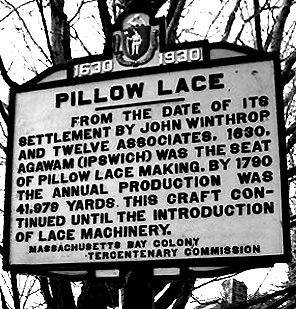
The Caldwell women were not just proper society ladies, handing out alms to the less fortunate and attending sewing circles — they were inventive, industrious, highly skilled crafters. The Lace Makers are the most noted among these laborious eager beavers. The Ipswich Historical Society asserts that lacemaking was the first women’s industry in America, and members of the Caldwell family were among the forerunners.

Lacemaking came on the scene early,* and this painstaking craft provided financial assistance for families during wartime. More importantly, it empowered the local women, giving them a sense of purpose and community. House & Garden references an Aunt Mollie Caldwell who collected the Ipswich workers' lace once a week and took it to Boston by stagecoach; in exchange, she brought back French calico, sugar, tea, coffee, and other goods, including surreptitious little packages of highly desirable snuff.


It wasn't the lace makers alone who were not paid in currency. Town records as far back as 1640 permit that "No persons are compelled to pay future debts in cash, but corn, cattle, fish and other articles." Mrs. Caldwell not only disposed of the workers' lace, she was also clever enough to buy a bit from a peddler, prick off a pattern from it, and give it to one of the workers to reproduce.

Samples of Ipswich Lace in linen and silk

In 1790, Alexander Hamilton urged the country to submit information on the manufacturing industry. Ipswich’s own Rev. Joseph Dana complied with a letter and 36 samples of lace collected from 1789 to 1790. Ipswich had 600 lace makers producing over 42,000 yards of bobbin lace within the year. Hamilton’s Report on Manufactures found "a Manufactory of Lace, upon a scale not very extensive, has been long memorable at Ipswich, in the State of Massachusetts." Dana used the new senator Cabot to entice Governor Trench Coxe to act as solicitor of Ipswich’s inventive women. Coxe brought the samples to a Philadelphia meeting.


Mary Boardman Caldwell was a part of this pioneer movement, as well as a leading maker and merchant of lace. Perhaps her talents in the craft of lacemaking were just as paramount as her networking skills. Mary was immersed in important social circles, and her marriage to Thomas Caldwell in Newburyport was a socioeconomic windfall, opening up a completely new territory of patrons. Some beautiful examples created by Lace Makers from Ipwsich and Old Newbury families: Elizabeth Heardsley and Sarah Greenleaf Boardman (Mrs. Offin Boardman) Benjamin Greenleaf Boardman
                                                                
            
George Lethbridge Saunders, an artist from England, traveled to the States from 1851 to 1853. During his stay, many prominent families commissioned him to paint miniature portraits. His works “meticulously represented the details of lace, jewelry, and background” of the time. Here is an example:


Boston Intelligencer Ad March 32 1827

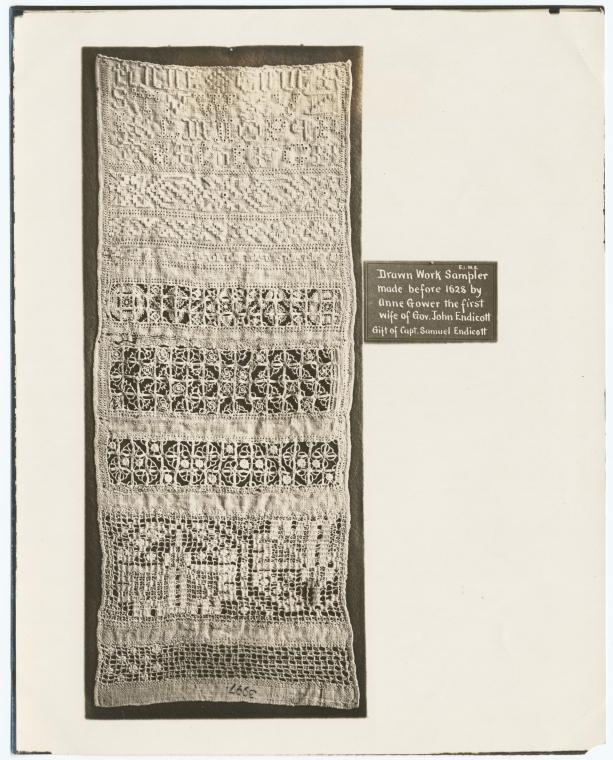
 * The oldest sample of lace, credited to Anne Gower Endicott (1620), is housed in the Peabody Essex Museum. It is an example of drawn-work with very fine lace designs and some lettering, including Anne’s name. She learned her craft during her childhood in England. She obviously had a great love for beautiful lace, and this work demonstrates her talent and skill. 

Ironically, her husband John Endicott set forth a law in 1634 prohibiting the “wearing of silver, gold and silk laces, girdles, and hat bands.” (See my Fashion War in the Colonies  in the Newburyport News for more info.)
The ministers and magistrates in Ipswich became ardent fashion police, but the public managed to work around the tight grip placed upon them. Occasionally a transgressor was taken before the court and fined, but to remain like Londoners, the spirit for finery and appearance won the day.

 
                          "The Lace Maker", Charles-Amable Lenoir


Sources
American Lace & Lace-makers Emily Noyes Vanderpoel, Amasa Stone Mather Memorial Publication Fund
Samplers and Tapestry Embroideries by Marcus Bourne Huish
A textile Lover's Diary
Salem in History
The Practical Book of Early American Arts and Crafts Harold Donaldson Eberlein, Abbot McClure, Mabel Foster Bainbridge
The practical book of American antiques, exclusive of furniture Da Capo Press, 1977
Publications of the Ipswich Historical Society, Issues 10-15
Ipswich in the Massachusetts Bay Colony Thomas Franklin Waters, Sarah Goodhue, John Wise
San Diego Union 1977 "She Laces with Dying Art"  

Sunday, June 30, 2013

Column: Ipswich's anti-slavery roots ran deep

From Melissa Berry See Wicked Local


Since its establishment, residents of Ipswich, Massachusetts played an instrumental role in eradicating the practice of human bondage, while campaigning rigorously to abolish slavery. In celebrating the 150th anniversary of the Emancipation Proclamation, along with Black History Month, it seems fitting to pay historical tribute to several men and women who once lived in the Ipswich community.

Two men from Ipswich helped plant the seed of anti-slavery. Nathaniel Ward initially set the precedent in his 1641 legal treatise entitled The Body of Liberties. In this first code of laws established in Massachusetts, Article 91 states that “there shall never be any bond slavery, villeinage, or captivity among us unless it be lawful captives taken in just wars.” Sharing Ward’s sentiment, Richard Saltonstall, founder of Ipswich and a magistrate of the courts, contested against the Captain of the “Rainbow,” who kidnapped two slaves from the New Guinea Coast in 1645. He denounced the act as "expressly contrary to the law of God and the law of the country." The guilty men were jailed for the "heinous crime of man-stealing," and Saltonstall mandated that both kidnapped men were to be sent home at the expense of the Commonwealth.

During the colonial period, many local slaves initiated the emancipation process by suing their masters for freedom. The victory of an Ipswich slave over her master became a potent example for future cases in the legal forum. In 1766, Jenny Slew successfully won her freedom after bringing her master, John Whipple, Jr., to the Superior Court of Judicature. A jury ruled four pounds in damages (issued 4 Dec. 1766, Records of the Superior Court of Judicature (Vol. 1766-7), page 175).

John Quincy Adams witnessed the Slew vs. Whipple trial, recording this entry in his diary on November 5, 1766: “Attended Court: heard the trial of an action called trespass… This is called suing for liberty; the first action that I ever knew of the sort, though I have heard of many.” While observing these trials, Adams wondered how a man set free is really free, if he is left in poverty with no foundation or blueprint to invent a new life. In a letter to Jonathan Sewall dated February 1760, he asks the Commonwealth, “Can he recover his legacy and how?”
Ipswich’s old families held significant positions within notable anti-slavery groups. The New England Anti-Slavery Convention assembled at Boylston Hall on May 27, 1834. William Oakes, Esq., Ipswich’s famous botanist, was appointed vice president, and the Rev. David Kimball, Pastor of the First Church, was named an officer. In 1839, James Appleton, a renowned public and political figure from Ipswich, became vice president of the Anti-American Slavery Society organized by famed abolitionist William Lloyd Garrison of Newburyport.

William Loyd Garrison

New England business men witnessed the increasing atrocities of slavery and corruption as the power struggle festered between the South and the North. One case in particular involving the capture of fugitive slave Anthony Burns helped turn the tides for many unionists. An attempt to rescue him turned into a blood bath at the court house, and Burns was transported back to Virginia to his owner. The notion that the government would honor this assault on liberty infuriated many. Amos Adams Lawrence, owner of Ipswich mills, recalled his anguish at this incident: “I went to bed an old fashioned, conservative,” he wrote, and woke up “a stark mad Abolitionist.” Afterward, Lawrence gathered the support of many prominent New England men to finance the anti-slavery movement, helping to make Kansas a free state.
As the movement gathered strength, locals opened up their hearts and homes to create a league of freedom advocates and reformers. The Old Parsonage house on North Main Street, owned by the Manning family, offered a hidden tunnel door where slaves could be secretly transported to freedom via cargo ships to Nova Scotia. The vestry at the Ipswich Methodist Church held anti-slavery meetings, as recorded in 1838 by Edwin Thompson, agent of the Essex County Abolition Society.


Not to be outdone by the men, the women of Ipswich were equally active in the struggle to end slavery. The Ipswich Female Anti-Slavery Society met at the home of Jazeb Farley. At the Ipswich Female Seminary, John Phelps Cowles and Eunice Caldwell Cowles openly expressed their antislavery sentiments, and pamphlets were circulated freely on school grounds. Mary Abigail Dodge, a teacher at the school, published her poetry in the National Era, an anti-slavery magazine.
 

George Russell compiled a scrapbook of anti-slavery poetry he collected from the Massachusetts Abolitionist during 1839 and 1840. Much of this poetry was authored by such noteworthy and popular poets as Elizabeth Margaret Chandler, Eliza Lee Follen, Lydia Sigourney, and John G. Whittier. The editors of the Massachusetts Abolitionist clearly hoped that the poetry might convince readers to acknowledge not only the horrors of slavery, but also the justness of political abolitionism (Holly M. Kent from Abolitionist Literature).

The final stop on our Ipswich anti-slavery tour is 16 Elm Street, home of Josiah and Lucy Caldwell. Josiah was Representative to the General Court, Selectmen, and Principal of Grammar Schools. He was also the first president of the Ipswich Anti-Slavery Society. Likewise, Lucy held meetings for the women’s counterpart organization and helped to produce anti-slavery materials. This warm, vibrant home became a pivotal influence in the community. The meetings featured lecturers, parlor games, and lots of jubilant singing.

Josiah and Lucy were spirited and generous people. Both fond of music and dance, Josiah, a “rich bass,” had a “remarkable voice of compass and power.” He composed a beautiful song, “Ode to Peace,” performed by the Handel Society. The Caldwells’ daughter, Mrs. Margaret Whipple remembered the “house was always open to many lecturers who came to Ipswich. I well remember Walker with the hand branded S. S. (Slave Stealer) for his efforts freeing slaves; and Torrey, who died a martyr to the cause in a southern prison, spending nights in this hospitable home.”


Ipswich residents should be proud of their ancestors and the former residents who served a higher cause. In the words of Josiah Caldwell, “God’s mercy reached our land. Peace came to heal the bleeding wound. Dispensing blessings wide around with an unsparing hand.” 

Ipswich Historical Society
Ipswich Visitor Center
Women Organized Against Slavery, 1688-1870 Part One
Gordon Harris Historic Ipswich
Ipswich in the Massachusetts Bay Colony Thomas Franklin Waters, Sarah Goodhue, John Wise. Ipswich Historical Society
The Westminster Review, Volume 84
The Origin of the Maine Law and of Prohibitory Legislation with a brief memoir of James Appleton
Women During the Civil War: An Encyclopedia by Judith E. Harper
Proceedings of the New-England Anti-Slavery Convention held in Boston on the 27th, 28th and 29th of May, 1834
One House, Many Stories by Robert Freedman
The Underground Railroads in Massachusetts by Wilbur H. Siebert
History of Essex County, Massachusetts with biographical sketches of many of its pioneers and prominent men (Volume 1) by Duane Hamilton

Legal Papers of John Adams, Volume 2
For the Press National Museum of American History
History of the Caldwell Family: John Caldwell and Sarah Dillingham Caldwell, his wife, Ipswich, Mass. 1654 [Genealogical records of their descendants, eight generations, 1654-1900 (1904)]

Popular Post