Showing posts with label Stearns. Show all posts

Sunday, February 19, 2017

George Cogswell School Class 1908 Haverhill Massachusetts

        StearnsGCSHaverhillBox 2 old family photos_0027 HRS back row third from left George Cogswell School grade 9 class of 1908
Stearns Family Photo Collection. George Cogswell School, Helen Stearns back row third from Left grade 9, age 13 class of 1908. See Stearns Family History Project

Helen Rachael Stearns daughter of William Dennett Stearns (son of Joseph Oliver Stearns and Helen Dennett) and Nettie Florence Gould (daughter of Nathaniel Gould and Rachel Peabody).
Rachael Peabody was daughter of Jacob Peabody (son of Jacob Peabody and Sarah Potter) and Elizabeth Perkins (daughter of Stephen Perkins and Deborah Hodgkins).


Stearns clippings'_0002
Helen’s father William Stearns with Harry R Davis, bank president Haverhill Savings  June 1943.

  WDS family photos_0010
The Stearns lived on Shawmut Ave in Haverhill MA. 1903 Photo of Stearns family Nettie, William, Howard and Helen.

Helen Stearns would graduate from Mt. Holyoke in 1917 and earn a doctorate from Yale. One Hundred Year Biographical Directory of Mount Holyoke College 1837-1937

Friday, November 28, 2014

Family of Bennett Franklin Davenport and Annie Emaline Coolridge & Ancestors


Bennett Franklin Davenport was born Birth 28 May 1845 in Cambridge, Massachusetts. He was the son of Charles Davenport and Joan Fullerton Hager. His grandfather was Joseph Davenport, of Newton, Massachusetts, a descendant of the Thomas Davenport, who settled at Dorchester in 1640.He was prepared for College at the Cambridge High School, and graduated from Harvard in 1867. Going abroad after graduation he attended for two semesters the University of Tiibingen, Germany, and upon his return became a medical student at Harvard, receiving the degrees of Master of Arts and Doctor of Medicine from that University in 1871, and also the Doctor's degree in Medicine from Columbia the same year for work done at the College of Physicians and Surgeons. Upon the completion of his professional studies he settled in Boston in the practice of medicine, with the specialty of a sanitarian and toxicologist and of an analytical and consulting chemist, examining chemically and microscopically foods, drinks, drugs, poisons, and other substances relating to health or to domestic uses. He is also an expert in court causes and the detection of forgeries and other falsifications and has figured in such cause: cé/ébres as the Molineux Trial, involving questioned handwritings, documents, and inks. Dr. Davenport was Coroner for Suffolk county prior to the establishment of the oflice of Medical Examiner. From 1879 to 1886 he occupied the Chair of Chemistry at the Massachusetts College of Pharmacy, was Chemist to the Massachusetts State Board of Health from 1882 to 1892, to the State Dairy Bureau from 1892 to 1900, and Dairy Inspector for the City of Boston from 1882 to 1885. He is Chairman of the Board of Health at Watertown, where he has resided since 1890, and also of its Park and Water Boards.
Besides the Massachusetts Medical Society, which he represented as delegate for the decennial revision of the United States Pharmacopoeia in 1880, 1890 and 1900, he holds membership in the leading city and state medical bodies, the American Public Health Association and the Massachusetts Association of Boards of Health, the American, London, Paris and Berlin Chemical Societies, the British Society of Public Analysis and the Society of Chemical Industry, the American and British Pharmaceutical Associations, and is a fellow of the American Association for the Advancement of Science.
Dr. Davenport is a charter-member and Corresponding Secretary of the Historical Society of Watertown, Chairman of its chapter of Sons of the American Revolution, a member of the New England Historic Genealogical Society, the Boston Society of Natural History, and the Phi Beta Kappa of Harvard. His reports in relation to sanitary affairs have been published in the annual reports of the Massachusetts State Board of Health and the Boston Medical and Surgical Journal. Besides being a prominent genealogist and historian, he was also professor of chemistry at Massachusetts College of Pharmacy (1879 - 86); served as Analyst for the Massachusetts State Board of Health, Lunacy, & Charity (1882 - 92) and as Coroner for Suffolk County (1875 -77), and was appointed a Justice of the Peace in 1893; published in The American Druggist, Harvard Register ("Recent Progress in Pharmaceutical Preparations"), and The Analyst (Royal Society of Chemistry, Great Britain), among many others; and was a noted authority on butter. In Forty Centuries of Ink (David N Carvalho, 2007), he is credited as having modified a formula for ink in 1900 that was subsequently used as the official ink of record in the state of Massachusetts, and, in 1901 (with the addition of "unnamed blue coloring material"), adopted by the US Treasury Department.
He married on July 23, 1873 Annie Emaline Coolidge daughter of John M Coolidge, JR. and Martha Jane Sturtevant. She was a cousin to President Calvin Coolridge. John Coolridge Sr married Martha Stone Bond. Bennett and Annie children: Grace Coolidge, John Coolidge, Anna Coolidge and Benita Coolidge Davenport.


Charles Davenport was son of Joseph Davenport and Susannah Beard Davenport. Below Photo Charles Davenport photo from Davenport & Bridges


From Scientific American, 28 August 1845
“Some of the most elegant cars ... run with a steadiness hardly equaled by a steamboat in still water, are manufactured by Davenport & Bridges, at their establishment in Cambridgeport, Mass. The manufacturers have recently introduced a variety of excellent improvements in the construction of trucks, springs, and connections, which are calculated to avoid atmospheric resistance, secure safety and convenience, and contribute ease and comfort to passengers, while flying at the rate of 30 or 40 miles per hour.”


Spruce Ave, Lot 1359 Burial: Mount Auburn Cemetery Cambridge Massachusetts, USA Below Photo Martha Jane Sturtevant, Annie and Herbert


  John M. Coolidge, Sr. (Deacon) and Wife Mary


View from side of first Coolidge home. Simon Coolidge Homestead, Grove Street. From this house, Joseph Coolidge went to his death on April 19, 1775. Herbert Coolidge was the last Coolidge born here. Birthplace of Annie E, Davenport (nee Coolidge), Grove Street. Annie Davenport was the wife of local Dr. Bennet Davenport (married 1873). They were charter members of the Historical Society of Watertown. She taught at the Coolidge School prior to her marriage. Annie was an original member of the Watertown Woman's Club and was their fifth president, 1905-1908. She was a founding member of the Watertown Chapter of the Daughters of American Revolution and the third regent, 1900-1903. John Coolidge, Sr. by door with hat in hand. Mary Coolidge (nee Bond), his wife seated. Albert Davenport by fence. Hired hand and child at back door.

Home of John Coolidge, Sr., Grove Street. Built around 1845. Bought by Mount Auburn Cemetery and demolished. Reading left to right: Charles Davenport, seated; Emma J. Davenport (Mrs. Albert M.), standing; Annie E. Davenport (Mrs. Bennett F.); Grace Coolidge (Davenport), a child; John Coolidge Jr., seated; Pat White, the hired man at the gate; Mrs. John Coolidge Sr. (Mary Stone Bond), seated; Charles Davenport, standing behind Alice and Mary Davenport (two little girls seated on the lawn); Mattie Coolidge on horseback; Mary Ellen Coolidge (daughter of Mr. and Mrs. John Coolidge Sr.) Grace Coolidge Davenport From DAR  


Lineage Book - National Society of the Daughters of the American Revolution, Volume 48
Wife of Henry J Winslow, Descendant of Joseph Coolidge, Joseph Sturtevant, Benjamin Davenport and William Hager  Daughter of Bennett Davenport and Annie Emeline Coolidge his wife Granddaughter of Charles Davenport and Joan Fullerton Hager his wife John Coolidge Jr and Martha Jane Sturtevant his wife Gr granddaughter of Joseph Davenport and Susanna Beard his wife John Coolidge and Mary Stone Bond his wife Reward Sturtevant and Ann Lovina Hesketh his wife Joseph Fuller ton Hager and Sylvia Bingham his wife Gr gr granddaughter of Benjamin Davenport and Sarah Wilson his wife Joshua Coolidge and Jemima Norcross his wife Lot Sturtevant and Elizabeth Bessel his wife William Hager and Abigail Fullerton his wife Gr gr gr granddaughter of Joseph Coolidge and Eunice Stratton his wife Joseph Sturtevant and Mary Gibbs his wife Joseph Coolidge 1720 75 was a minute man from Water town at the battle of Lexington where he was killed Joseph Sturtevant 1734 1808 served as a minute man at various alarms 1777 8 He was born and died in Ware ham Lot Sturtevant 1759 1848 enlisted 1777 for three years under Capt Joshua Eddy and Col Gamaliel Bradford He was placed on the pension roll 1818 for three years actual service as private He was born in Wareham Mass died in Waterville Maine Also Nos 18431 21579 Benjamin Davenport 1743 1833 was a private in Colonel Gerrish's Massachusetts regiment 1778 He was born in Newton died in Needham Mass William Hager 1749 1830 served as a wagoner at the fortification of Dorchester Heights 1776 He was born in Waltham, Mass died in Boston. 


Massachusetts State Representative Henry Joshua Winslow son of Henry Hedden Winslow and Margaret Ella Givens

Information from Uncommon Ancestors and Genealogy and memoirs of Isaac Stearns and his descendants (1901), Genealogy of Edward Winslow of the Mayflower, and his descendants, from 1620 to 1865
On Feb. 4, 1874 Henry Hedden Winslow married Margaret Ella Fuller in New Bedford, Massachusetts. In 1876 they moved to Cambridge where their three children were born:
  1. Mary H. Winslow born Feb. 11, 1876
  2. Edith Baker Winslow (Stearns) born Aug. 10, 1878
  3. Henry Joshua Winslow  born June 27, 1880
Henry born in Elizabeth, New Jersey, May 5, 1847.  He was the son of Joshua Baker Winslow, a sea captain and Mary Dehart (Bruen), who made their home in New Bedford, Massachusetts, where their son was educated.
Margaret Ella Givens born in Nobleboro, Maine about Dec. 23, 1844 to Benjamin Hall Givens, a seaman, and his wife Mary Ann (Hussey).

Margaret Ella Givens
 
Henry H. Winslow

Mary H. Winslow
daughter of Margaret and Henry Winslow

Edith Baker Winslow Stearns &
Margaret "Peggy" Winslow Stearns
1907

Obit of son Henry Davenport Winslow March 11 1999
Henry D. Winslow, 88, of Lexington, MA, formerly of Cambridge, MA, after a long illness died Monday (March 8, 1999). Beloved Husband of Katharine (Nichols) Winslow. Born in Cambridge, MA, he was the son of the late Henry J. and Grace D. Winslow. Besides his wife of 64 years, he is survived by his son, Henry N. Winslow and daughter-in-law, B.J. Winslow of Newtonville, MA; his daughter, Katharine W. Herzog and son-in-law, Dr. Alfred Herzog of Glastonbury; and two granddaughters, Katharine H. Dube of South Harpswell, ME; and Anne W. Herzog of Arlington, MA. He was the father of the late Philip N. Winslow of New York City. Memorial Services at the First Parish Church Cambridge Unitarian Universalist on April 10 at 2:30 p.m. In lieu of flowers, donations may be made to the First Parish Church Unitarian Universalist, 3 Church St., Cambridge, MA 02138 or to the charity of one's choice. Arrangements by the Douglass Funeral Home Lexington, MA.


Information from Universities and Their Sons: History, Influence and Characteristics of American Universities, with Biographical Sketches and Portraits of Alumni and Recipients of Honorary Degrees, Volume 4, The College of Physicians and Surgeons, New York, and Its Founders, Officers, Instructors, Benefactors and Alumni: A History, Volume 2, and Secretary's report, Issue 11 By Harvard College.
See THE DAVENPORT FAMILY Communicated by Bennett F Davenport MD of Boston New England Historical and Genealogical Society. Daughters of the American Revolution.


Saturday, November 15, 2014

Farrar Pottery

This family was full of talent! Although I found the pottery they crafted I have only some of the genealogy. If you have any information or pictures of descendants please post or e-mail me Thanks

Isaac Brown Farrar the third son of Rev. Stephen Farrar bom March 27, 1771, married Anna or Alma Lawrence, daughter of Dr. Ebenezer, Lawrence, of Pepperell, He lived in New Ipswich, merchant, Innholder, and Militia Officer, removed to Fairfax, Vt., where he died 1838
Ebenezer Lawrence
Stephen married Anna Muzzy, his cousin;
Ephraim Hartwell
Isaac, married Eveline Farrar of Middlebury, Vt.
Caleb Farrar, the 7th son of Rev. Stephen Farrar born June 1780, married Sarah Parker of New Ipswich, March 15, 1804, and lives at Middlebury, Vt.   More family below in post

Political Stoneware Jug, Abraham Lincoln "Old Abe Prest" Brushed in Cobalt, One Gallon Lyman Stone - Waterbury VT - 1862 - Old Abe Prest Unique cobalt decorated stoneware jug impressed S. Johns Stoneware under spout; the factory was operated by George W. Farrar in 1862. Lyman Stone (1800 - 1870) listed in 1850 census   blacksmith in Waterbury. One of only three extant pieces of stoneware referencing Lincoln.  $18,985


Farrar, 1850's 5 gallon butter churn with triple flower design all in great blue. Sold for $850 at Waasdorp's American pottery auction on 10/2010.


W. H. FARRAR / GEDDES, NY Stoneware Jug with Exceptional Slip-Trailed Bird and Floral Decoration 
March 1, 2014 Stoneware Auction by Crocker Farm, Inc.


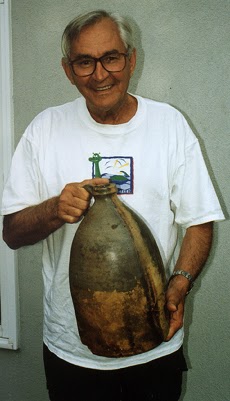
Wile scuba divng, July 27 1997, facing "Belmere", which was once Sir Huh Allan's residence on Lake Memphremagog, he found a two gallon jug. It bore the insription "E.L. & G.W. Farrar, Fairfax, VT." He realized he had found an artifact that could be as much as 150 years old and certainly part of his distric's heritage.Treasures ....in Memphremagog lake by Jacques Boisvert- President August 1997


Jacques Boisvert notes: A bill of sale is shown dating August 26 1840, from the VERMONT STONE WARE firm, owned by Georges W. & J. H. Farrar of Fairfax, Vermont. From that bill we note that the 2 gallon jug was selling for $43.00 a dozen, which is about $0.35 each.
The father Isaac Farrar started pottery business. He was in Enosburgh, VT, in 1798. Farrar was the first clerk of that town and his daughter was the first white child born there. We do not know in which year he moved to Fairfax, but according to a jug kept at the Brooklyn Museum (NY) marked I.B. Farrrar & Sons, we may guess that it was around 1815, as his sons would not have been old enough then to be in business with their father.
His son Ebenezer Lawrence (E.L.) and the one bearing the initial J.H. were in business in 1840 as the bill noted mentions.Eventually Ebenezer Lawrence (E.L.). bought the Farrar & Soule pottery at St. John, Quebec and George Whitefield (G.W.) Farrar. his brother became associate with him in 1857.
In a small publication entitled: LA POTERIE AU QUÉBEC, une histoire de famille we can read: "It is impossible in the first years of "Farrar pottery", to trace a clear demarcation line between the activities of the Canadian and American Farrarr. The story of these potters of St. John, Quebec is closely related to the potters of Vermont. Two Farrar brothers, died in the burning of a steamboat on the St. Lawrence River. This ship bore the name "THE ST.LAWRENCE". They were among 200 victims that loss their life in that incident.
 

Some Information recorded from Canadian Biography
 

George Whitefield Farrar potter; b. 29 April 1812 at Fairfax, Vt, son of Isaac Brown Farrar and Alma Lawrence; m. 25 Sept. 1836 Sophia Adams Winslow at Barre, Mass., and they had three sons and one daughter; He d. 28 Jan. 1881 at Iberville, Que
 

George Whitefield Farrar came of a family whose roots in North America went back to the 17th century, to Jacob Farrar, who emigrated from England to Massachusetts in or about 1653. In the 18th century George’s father settled in Vermont and eventually established a pottery at Fairfax. It was at this pottery that George received his training.

He continued as a potter in Fairfax until the 1850s, when he crossed the Canadian border to Saint-Jean (Saint-Jean-sur-Richelieu). Other members of the extensive Farrar clan had for some years been engaged in potting there and had introduced the making of stoneware to the area. In 1857 he entered into a partnership in Saint-Jean with his potter-brother, Ebenezer Lawrence Farrar. The partnership was announced in the Saint-Jean News and Frontier Advocate as effective from 13 April 1857. It was short-lived, for less than three months later Ebenezer lost his life in the burning of the steamboat Montréal on the St Lawrence. George W. Farrar carried on the business in Saint-Jean, and across the Richelieu River at Iberville after fire destroyed the Saint-Jean plant in 1876. He was joined, when they were old enough, by his sons; the two who had most to do with the pottery were George Henry and Ebenezer Lawrence. At various periods the pottery was officially operated under his sons’ names, but he always maintained an interest in it. After his death it continued in the family name until 1926 when George H. Farrar sold it. The pottery closed in the early 1930s.

The Farrars’ products were the common earthenware and stoneware of the North American potter Articles produced were almost entirely utilitarian: snuff jars, bottles, spittoons, jugs, teapots, butter pots. Within this range, quality was good. George W. Farrar was awarded a medal for earthenware at the provincial fair in Montreal in 1860; under his sons’ names the factory’s stoneware was exhibited abroad, at Philadelphia (1876) and Paris (1878). In 1861 the pottery used up some 500 tons of clay (stoneware clay was imported from New Jersey) and employed 18 hands. By the 1870s steam power had been installed and 40 persons were on the payroll; the pottery was now one of the largest in Canada.

But George W. Farrar’s accomplishments did not end with the production of dark-bodied earthenware and salt-glazed stoneware. He was the promoter of the St Johns Stone Chinaware Company, the first whiteware pottery in Canada, established in 1873. Because, like most Canadian potters, Farrar never made much money, he lacked capital to embark on such an ambitious venture as the formation of the company on his own, but his was the moving spirit behind it. 


Much of the required capital came from Edward C. Macdonald, the company’s president and a “merchant prince” of Saint-Jean, who bought the company outright when it slipped into bankruptcy in 1877. Farrar himself was connected with it for only a brief period – he withdrew early to take back the management of his own pottery – yet his had been the vision of a new dimension in Canadian potting: the first commercial production of whiteware.

The News and Frontier Advocate summed up his importance when George W. Farrar, a former councillor of Saint-Jean, died in 1881: “Mr. Farrar encountered many difficulties in this country but he was . . . ever enthusiastic in his schemes. He was undoubtedly the promoter of the St. Johns Chinaware . . . factory, which is at present doing such a large and flourishing business and as he was but a short time connected with the concern, its lack of success at the outset cannot certainly be laid to his charge.” 


A beautifully decorated two gallon jug from E.L. & M (Ebenezer Lawrence and Moses) Farrar of St. Johns Canada East. Circa 1855. Decorated pieces from this short-lived early partnership are rare. The quality of this design suggests it may have been a special piece. The initials "N.M" are the potter's.  

Farrar Redware Crock Made at L.W. Farrar Pottery (1831-1850), Fairfax. Incised mark: "L. W. Farrar."
FAIRFAX POTTERY FALLS INTO 2 CATEGORIES:
1 - Red Earthware fashioned from native clay. Native clay was found in river beds and near large bodies of water.
Redware is one of the least durable ceramic types. Porous and brittle, it easily cracked and chipped. Red earthware has not survived in quantity. It was intended for the humbler domestic purposes. The local glacial clay was also used for common bricks.

2 - Stoneware made with materials brought from outside the New England states. This material was transported from New York, New Jersey and Pennsylvania.
Isaac Brown Farrar, son of Rev. Stephen Farrar, was born March 27, 1771. He was born and raised in Ipswich, N.H. He left New Hampshire in the year 1798. I.B. Brown was a potter.
Isaac Broun Farrar appeared in Enosburgh, VT in 1798. No one knows when he appeared in Fairfax, VT. I.B. Farrar had a son, Isaac Brown, who married Eveline Farrar, a cousin.
Eveline's father was Caleb Farrar of Middlebury, VT. Caleb was a well-known potter.
Other sons were Ebenezer Lawrence, Stephen and George W. J. H. Farrar (1840) may stand for another of Isaac's boys.
Records indicate that Isaac Broun Farrar, Sr. died in 1838 at 67 years of age.
Ebenezer Lawrence Farrar did business under his own name and also in partnership with G. W. Farrar.
In 1852 E. L. Farrar was in Burlington, VT., where he built a pottery work for the firm of Nichols and Alford.
Another Farrar, whose given name has not come to light was in partnership with one Stearns in 1851 and 1852. He may have been the son of Ebenezer Lawrence Farrar. Farrar & Stearns can be found on pottery. They made stoneware.
Lewis & Cady were also stoneware manufacturers. Pottery with their names can also be found.
Bostwick was also a name associated with Fairfax Pottery. Fairfax Historical Society has a piece of Bostwick Stoneware.
Below are some of the names found on Local Fairfax Pottery:

E. L. Farrer
Farrar & Stearns
Lewis & Cady
Fairfax, Vt
Farrar Pottery
E.L. & G.W. Farrar
I. B. Farrar & Son
Farrar & Hubbell
Farrar & Soule
S. H. & G. W. Farrar
Farrar & Woodworth

The above information was provided by Marvin Alderman, formerly of Fairfax who is extremely knowledgeable of pottery. "ONONDAGA - POTTERY CO. 1841, in Syracuse, New York, W. H. Farrar operated a pottery to make Rockingham. 1855 -1871, the plant was called the Empire Pottery. 1871, the plant was re-organized and the name changed to Onondaga Pottery Co. 1966, the name became Syracuse China Onondaga Pottery made china dinnerware.

In The Pottery and Porcelain of the United States: An Historical Review of American Ceramic Art from the Earliest Times to the Present Day E A Barber notes:
Caleb Farrar established a pottery in Middlebury, Vermont, about 1812, for the manufacture of earthenware and white tableware. About 1850 Farrar sold the works to James Mitchell, who continued the business until his death, after which the pottery was purchased by Nahum Parker. The buildings were afterwards converted into a dwelling house, which is now or was recently occupied by Mr. P. V. Hathaway, who married a member of the Farrar family. Among other varieties of ware, green glazed pottery was at one time produced there. A specimen may be seen in the collection of the Pennsylvania Museum, Philadelphia. This is a mug of common earthenware covered with a yellowish, apple-green glaze.

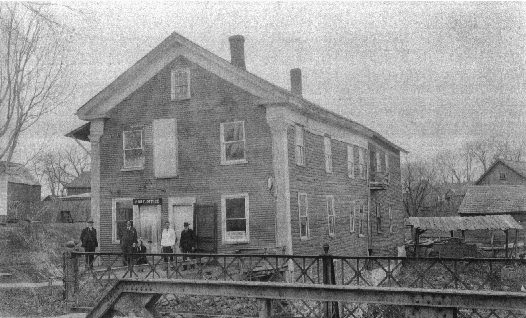
This building that used to be just below the Koch House is thought to have been the Farrar Pottery Business at one time Vermont Historical Society 


Engraving E. L. & G. W. Farrar, Pottery John Henry Walker (1831-1899)1853, 19th century
See Alfred K. Ballard Pottery Co. Collection From Marjorie P. Kohli, Waterloo, Ontario, Canada, 1999


4 gallon jug made by the W. H. Farrar & Co, with the incredible full bodied dotted rooster decor, just sold for $11,750.00 - This one was manufactured in Geddes, N.Y, not Fairfax, but by the same company that originated in Fairfax then expanded and moved to both St. John's, P.Q., Canada and Syracuse, N.Y. 


For more images Skinner Auctions 
"Early New England Potters and their Wares"
American Stoneware by William C. Ketchum, published by Henry Holt and Company, 1991

Lords of the North By James K. McDonell, Robert Bennett Campbell

Elizabeth Collard

Popular Post