Showing posts with label Melissa D Berry. Show all posts

Tuesday, March 17, 2015

Emerson Baker: A Storm of Witchraft | Salem, MA Patch

Emerson Baker: A Storm of Witchraft | Salem, MA Patch
Melissa's review is also on Line at Salem Gazette


Emerson “Tad” Baker offers a fresh perspective on the 1692 Salem witch hysteria in his new book “A Storm of Witchcraft: The Salem Trials and the American Experience.” Baker is creating a buzz and # 1 on the Barnes and Noble list for Hot Colonial reads.
What tempest of dark forces brewed in Salem Village? Baker asserts it was a culmination of climatic events just waiting to unleash its fury. When you mix a small pox epidemic, crop failure, Native raids, frontier wars, a government upheaval, Puritan oppression along with three decades of bad blood squalls you have a perfect storm.
According to Baker, these combined threats convinced Puritans authorities that God had frozen them out. By 1692 the chilly atmosphere in Salem was more like a medieval waste land than a New Jerusalem. The elitist ice den pressed for more frigid conditions hoping to purge evil, but as Baker will show it ended their icy reign.
What makes Baker’s story stand out from the “crowded field” of other scholars is his focus on the family relations. Although past authors have dismissed the significance of genealogical research, Baker asserts it is essential. It helps the reader understand the human behavior of the colonial clans, as well as the actions of the courts. It also outlines the Puritan mindset.
As noted by the editor, Baker will “awaken your primal emotions with the personal accounts.” He probes deep into psyches exposing raw emotions such as fear and jealousy which help trigger the hysteria. He also addresses the patterns of friction and tension among the society.
Peg Plummer, a Mayflower descendant loved the “added complexity of the family connections of the accused, accusers and judges.” Plummer says that her interest in genealogy made her “appreciate Baker’s detailing of the close-knit group of the judges and admits it must have been hard to disagree with a colleague if he’s also your brother-in-law, fellow merchant and Governor’s counselor.”
The pedigree profile Baker outlines on each judge will show a collective force of opportunist merchants and ministers entering into strategic marriages. Baker divulges their methods of ferreting out devilish dissenters and provocateur parishioners before and during the trials.
Rev George Burroughs would be trapped in the turbulence even after a geographical relocation. Was this Harvard educated minister really contaminating his congregation with Satan’s black arts? Or, was he like John Alden possessed by the spirits of the open frontier? Alden was accused of bewitching soldiers and being in league with the enemy Pagan Natives. Baker defines the “perfect witch” as one who had problematic histories due to political, religious, and military conflicts. They were “part of Satan’s grand collation bent on destroying Puritan Massachusetts.” .
Baker demonstrates how festering feuds among relations, neighbors and court officials would play a part in the witch hunt. The Bradbury line had a long history of strife with those on the bench and pulpit. Additionally, there were Quakers in Mary’s line and her husband had shown public sympathy toward the sect as a court official.
Rebecca Nurse stood charges for tormenting a neighbor who was trying to settle a score and was also under suspicion for having harbored the children of The Southwick family who were Quakers.
Many of the accused would be targeted for Quaker associations. In fact, Baker will offer many accounts to show how victims fingered for witchery had relations who suffered the Quaker persecutions. The judges who ordered the gallows executions are the sons of the judges who whipped and branded Quakers.
Jason Starbuck Morley, a direct descendant of Quaker Thomas Maul says the book “is an outstanding new addition to the trove of scholarship on the 1692 Salem Witchcraft Hysteria and by far the best account he has read on the subject.” Morley further adds: “Although I have collected dozens of books on the trials, this is far and away the best account I have read on the subject. Unlike other histories, his account includes a comprehensive background on the Salem/Puritan community out of which the trials arose. Baker has added a new dimension to the story of 1692 by placing in within the context of Salem, itself. The book touches on Salem’s Quaker community, the effect of wars on the Maine frontier, economic crises, political upheavals and the peculiar social relations found in a Puritan community. Although comprehensive in scholarship, it remains highly readable; thus making it a superb contribution to the body of scholarship on the Trials.”
Heather Wilkinson Rojo, historian and author of the Nutfield Genealogy blog also has several ancestral ties to the early Salem community and notes: “As a genealogist, this is fascinating stuff and Baker succeeds in telling the “whole story with all flesh on the bones.” Rojo further adds, “While most of the other accounts just focus on one or two angles of the story, Baker really covers it all--before, during, and after.”
Rojo also shared that after hearing “A Storm of Witchcraft” lecture she was captivated by Baker’s theory on how the Salem Witch trials were one of the first governmental “cover up stories” in American history. The Puritan government tried to cover up all their mistakes made in the trials to the English authorities, and to the people themselves. They also tried to preserve their tentative hold over the people with the inter-related judges, magistrates and ministers.
Despite the fact the actual court records were not released to the public until 1979, Baker presents several examples of how “Witch City Salem” is very much alive in memory. His work will offer each “throbbing heart” in the experience and readers will appreciate why generations of descendants like Benjamin Franklin and Thomas Jefferson “have dedicated to the proposition it must never happen again.”                
More coming on AnceStory Archives
Please visit Baker at www.salemstate.edu/~ebaker and look for his feature Salem End: The Diaspora That Followed the 1692 Witchcraft Crisis in “ American Ancestors” magazine this month.

Monday, February 9, 2015

Dr. Soren Meibom: A man of science and art

My article from Winchester Star Read on line A man of science and art

Also visit Dr Meibom @ Harvard-Smithsonian

Dr. Soren Mebom American Astronomical Society press conference in Seattle


A
painting of the jazz musician John Lee Hooker was selected for the
Smithsonian’s 2015 Artists at Work exhibition and will be on display at
the S. Dillon Ripley Center in Washington, D.C. from Feb. 4 through May 1
of this year. - See more at:
http://winchester.wickedlocal.com/article/20150131/NEWS/150139652/?Start=2#sthash.bqI9xWTG.dpuf
A
painting of the jazz musician John Lee Hooker was selected for the
Smithsonian’s 2015 Artists at Work exhibition and will be on display at
the S. Dillon Ripley Center in Washington, D.C. from Feb. 4 through May 1
of this year. - See more at:
http://winchester.wickedlocal.com/article/20150131/NEWS/150139652/?Start=2#sthash.bqI9xWTG.dpuf
A
painting of the jazz musician John Lee Hooker was selected for the
Smithsonian’s 2015 Artists at Work exhibition and will be on display at
the S. Dillon Ripley Center in Washington, D.C. from Feb. 4 through May 1
of this year. - See more at:
http://winchester.wickedlocal.com/article/20150131/NEWS/150139652/?Start=2#sthash.bqI9xWTG.dpuf
A painting of the jazz musician John Lee Hooker was selected for the Smithsonian’s 2015 Artists at Work exhibition and will be on display at the S. Dillon Ripley Center in Washington, D.C. from Feb. 4 through May 1 of this year.


Saturday, January 3, 2015

Rocky Hill Meeting House Amesbury

From Stearns Family Photo Collection  sent by Ruthie Stearns  Please ask for permission to post or copy photo  


Rocky Hill Meeting House is run by Historic New England one of the best preserved examples of an original eighteenth-century meeting house interior. It was built in 1785, replacing a c. 1715 meeting house for the West Parish of Salisbury. Rocky Hill Meeting House was strategically placed along the only road that crossed the swift Powow River (via ferry) and led travelers to the Salisbury Point area, and then onward toward Portsmouth. In fact, George Washington paused here to greet the townspeople on his northward journey in 1789. See Article by Historic New England Location, Location, Location 
Located at 4 Old Portsmouth Road Amesbury, Mass. 01913

Architectural Highlights of Boston's North Shore

John Goff historian, architectural historian, restoration architect and preservation consultant featured in Antiques and Fine Arts Magazine explores Six Historic Homes in the Boston, Massachusetts area. The Whipple house in Ipswich, The Spencer-Pierce-Little Farm in Newbury, The Derby House and Gardner-Pingree House in Salem, The Jeremiah Lee Mansion in Marblehead, and Beauport in Gloucester.

Spencer-Peirce-Little Farm, Newbury preserved by Historic New England
Boston's North Shore was first settled by English colonists soon after the Mayflower Pilgrims disembarked at Plymouth, along what is now the southern Massachusetts coast, in 1620. The Cape Ann colony, where Gloucester and Rockport are situated on the North Shore, was settled in 1623. In 1626 the colony reorganized at Salem, then called Naumkeag. Although the first dwellings erected by the colonists in New England were often rude temporary shelters, such as English wigwams, dugouts, and tents, by mid-century a type of dwelling was introduced that architectural historians call the post-mediaeval or multi-gabled house.

The homes of this period were typically built of heavy timber frame and furnished with a large central brick chimney, a steep pitched roof with wood shingles, and split wood clapboards or weatherboards on the walls. The finer examples could have had multiple large triangular dormers at attic level, framed overhangs with pendant drops, projecting entry porch pavilions, and casement windows with small diamond panes held together with lead cames. The Whipple House in Ipswich is an opulent example of a substantial English multi-gabled house of the so-called "first period" (ca. 1630-1730). See More of this article at Antiques and Fine Art Magazine  

John Goff is the principal of Historic Preservation & Design and president of Salem Preservation, Inc. (SPI), worked with the City of Salem to restore Salem in 1630: Pioneer Village, America's oldest living history museum.
A landmark year: Milestones marked for Pioneer Village, the Arbella and more See Facebook Antiques & Fine Art Magazine
More about homes in article on blog
Captain Richard Davenport and Elizabeth Hathorne - Salem Witch House 
Salem Cornerstones: Cornerstones of a Historic City Salem's Witch House:: A Touchstone to Antiquity


Sunday, September 21, 2014

George Thompson Garrison and the 55th


1st Lieutenant (55th Regiment) George Thompson Garrison was born February 13, 1836 and died January 1, 1904 son of William Lloyd Garrison and Helen Eliza Benson Garrison. He married Annie Keene Anthony on October 1, 1873. Annie was d. of John Gould Anthony and Anna W Rhodes
All seven of the Garrison children were named for Abolitionists.  The first, born in 1836, was named for the English abolitionist, George Thompson, whom Garrison met on his 1833 trip to the UK.  Thompson has experienced in England some of the same intense verbal vitriol, calling him “fanatic”, similarly experienced here by Garrison. They became constant co-laborers in the international abolitionist cause.
May 25, 1836
Garrison, writing to Helen, tells of a letter from George Thompson.  “T. says…that our dear babe, with such a name as he has got, must really be a double dipped fanatic — George Thompson GARRISON !!”
George, not sharing his father's scruples, enlisted in the Fifty-fifth Colored Regiment of Massachusetts Volunteers, attaining the rank of captain. He was a printer before he went into the war. 
Read about George T Garrison's tent found in family attic 
George T. Garrison's Trunk, National Museum of African American History and Culture


Garrison Family 1876 Newburyport MA Smith College Collection


 William Lloyd Garrison and his daughter Fanny (Helen Francis) , carte-de-visite, ca. 1856. From Boston's Crusade against Slavery  C. Seaver, Jr., photographer (Boston, Mass.)


Photo From William Lloyd Garrison, 1805-1879; the story of his life told by his children. George Thompson, abolitionist age 40


 Wendell Phillips, William Lloyd Garrison and George Thompson 1851

Garrison Family Papers, 1694-2005
Visit Smith College Library for more Garrison Information
Francis Jackson Garrison, William Lloyd Garrison, 1805-1879; the story of his life told by his children: volume 2 
The Memorial History of Boston: Including Suffolk County, Massachusetts Chapter 6 (1882)
A House Dividing Against Itself, 1836-1840 By William Lloyd Garrison
Mayors of Boston: An Illustrated Epitome of who the Mayors Have Been and what They Have Done
The Life and Times of Wendell Phillips by George Lowell
"Anti-Slavery Excitement" in Boston

Monday, July 28, 2014

William Lloyd Garrison Mob Boston 1835

The lock which was used to secure Garrison in a prison, for his protection from men who wanted to lynch him, during the October, 1835 mob action.

From The Liberator Files 1831-1865


A Moment in Abolition History

A view by Horace Seldon

Often history records an event which later is seen as a crucial “moment”, filled with meaning beyond the specific time, place and personalities involved. Such a time happened in London, in June, 1840. In another place I’ve written about the international significance of that time, when Garrison and other men from New England refused to participate in an international anti-slavery convention, because women delegates had been denied recognition. The effect on the movement became significant as a “watershed moment”.

In Boston, in 1835, a similarly significant “moment” occurred, once again with William Lloyd Garrison at the center, this time encountered by an angry “mob”. To tell the story I will rely on Garrison’s own words, on the historical accounts of Henry Mayer, and of Garrison’s sons, Wendell Phillips Garrison, and Francis Jackson Garrison. Any particular “moment” has a historical context, and the year 1835, is a time which Garrison himself called a “reign of terror”, threatening individual abolitionists and the movement itself. See Papers to Garrison Mob by Lyman


On the left is Wendell Phillips, son of the City of Boston’s first mayor, eloquent Abolition speaker; Garrison in the middle; on the right, George Thompson, English Abolition leader, close collaborator with Garrison. The Garrisons named two of their sons after Phillips and Thompson. Photo from Rare Book Room Boston Public Library

In New England in premonition of “terror”, late 1834 saw the destruction of Prudence Crandall’s school in Canterbury, Connecticut. She had opened her school for young black women, and that act enflamed a hatred that warned abolitionists of the depth of what previously Garrison had called the “mountains of ice” which needed to be melted. Then came the hot hatred of 1835. In Charleston, South Carolina, a post office was seized by a crowd of people who seized mailbags full of anti-slavery pamphlets; the fire which burned the literature became the scene of the hanging of effigies of Arthur Tappan and Garrison. In Nashville, Amos Dresser, a young man who had joined abolitionist protests at Lane Seminary, was publicly assailed and lashed twenty times in the public market.


Prudence Crandall (September 3, 1803 - January 28, 1890), a schoolteacher raised as a Quaker, stirred controversy with her education of African-American girls in Canterbury, Connecticut. Her private school, opened in the fall of 1831,was boycotted when she admitted a 17-year-old African-American female student in the autumn of 1833; resulting in what is widely regarded as the first integrated classroom in the United States. She is Connecticut's official State Heroine.

In Canaan, New Hampshire, voters of the town assembled in town meeting, and acted to appoint a committee to oversee the physical removal from the town of Noyes Academy. That Academy had been started to educate young black children, under leadership which included one of Garrison’s devotees, David Child. Also in New Hampshire, in that same year, in a church in Northfield, George Storrs, was lifted from his knees while offering an anti-slavery prayer, and thrown out of the church! This “reign of terror” became very real for Boston, and for Garrison.

George Thompson, strong abolitionist leader from England, had come to the United States in the previous year, and was still touring the country in 1835. His speeches brought strength to the movement here, but he was under constant threat wherever he appeared. At an August speech in Boston abolitionist women had cleverly maneuvered him away from a threatening crowd. In the same month, a stone meant for Thompson, was thrown through a window, where he was speaking, in Lynn. Slaveholder hatred and fear took radical form. Subscriptions to a fund for procuring the heads of Garrison, Thompson, and Tappan, were invited to be made through a bookstore in Norfolk, Virginia. The Richmond Enquirer urged that these “wanton fanatics” be “put down forever”, and warned the North against interference with the right of slavery. Some Northern commercial interests, threatened with the loss of Southern patronage, or the destruction of Southern branches, responded by bringing pressure against abolitionists in Boston.


George Thompson, at age 47, in 1850-1851. United Kingdom abolitionist, close friend and ally to Garrison, after meeting in London, in 1833

One Boston newspaper, the Commercial Gazette, responded to an announcement of an August 14 annual meeting of the Boston Female Anti-Slavery Society, and predicted resistance. “This resistance will not come from a rabble, but from men of property and standing, who have a large interest at stake in this community…” The paper warned ladies to keep away, and threatened that if Thompson were to appear, he would be lynched.

Faneuil Hall was denied for abolitionist meetings, but on August 21, the same Hall was filled with those who wanted to “protect the rights of the South”. Harrison Gray Otis, retired Mayor, was a featured organizer-speaker for that crowded meeting. Otis spoke of the intent of abolitionists to create auxiliary societies in “every state and municipality”, asserting that this proved them to be “imminently dangerous” and “hostile to the spirit and letter of the constitution”. In the same period Samuel May had a speech broken up in Haverhill, and John Greenleaf Whittier was pelted with eggs in Concord. The Garrison family was frightened by a gallows which was planted on the doorstep of their home, on Brighton Street.

The postponed meeting of the Boston Female Anti-Slavery Society, was announced for three o-clock on Wednesday afternoon, October 21st. It was to be held at 46 Washington Street, in a hall at the Anti-Slavery office. The Commercial Gazette reported on the indignation among business men who thought that “women ought to be engaged in some better business than that of stirring up strife between the South and the North on this matter of slavery… they ought to be at home, attending to their domestic concerns …”

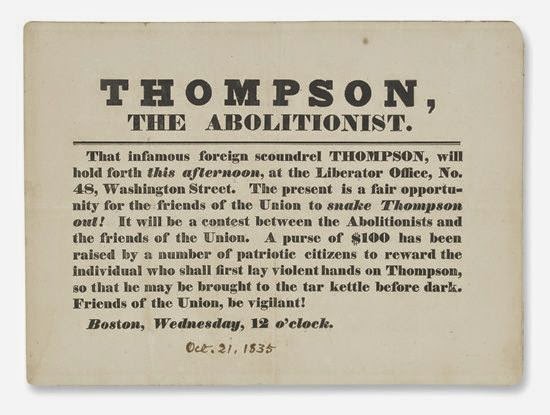
Believing that George Thompson was to speak, anti-abolition forces distributed handbills which urged people to “snake out” Thompson, and offered a one hundred dollar prize for the first to lay violent hands on him. It hoped that Thompson would “be brought to the tar-kettle before dark”. These warnings were widely distributed to insurance offices, hotels, reading rooms, from State Street to the North end. Fearful merchants petitioned Mayor Lyman to prevent the meeting. Photo from Caren Collection


On the day of the meeting, a crowd had gathered along Washington Street, and in the vicinity of City Hall. Hisses, sarcastic cheers, racial epithets were accompanied by demands for “Thompson”. The crowd was assured by the Mayor, who had arrived, that Thompson was not in the building. Word spread soon that Garrison was there. He had come from his home on Brighton Street, where he had hosted a dinner for John Vashon, a leader of the Pittsburgh colored community; he was accompanied by Charles Burleigh, abolitionist from Connecticut. Garrison, after consulting with the women leaders of the meeting, retired into the Anti-Slavery office, separated from the gathering by a partition. (See Letters to John Vashon--Garrison)


The birth of John Bathan Vashon in 1792 is celebrated on this date. He was a Black seaman, businessman and abolitionist. 

The President of the Society, Mary Parker, proceeded with the business of the meeting, with the customary prayers and reading of Scripture. She was interrupted by the Mayor bursting into the room, requesting that the ladies abandon the meeting and go home. A conference between Parker, Maria Chapman, and the Mayor resulted in the decision by the ladies to adjourn the meeting and reconvene at the Chapman home at 11 West Street.

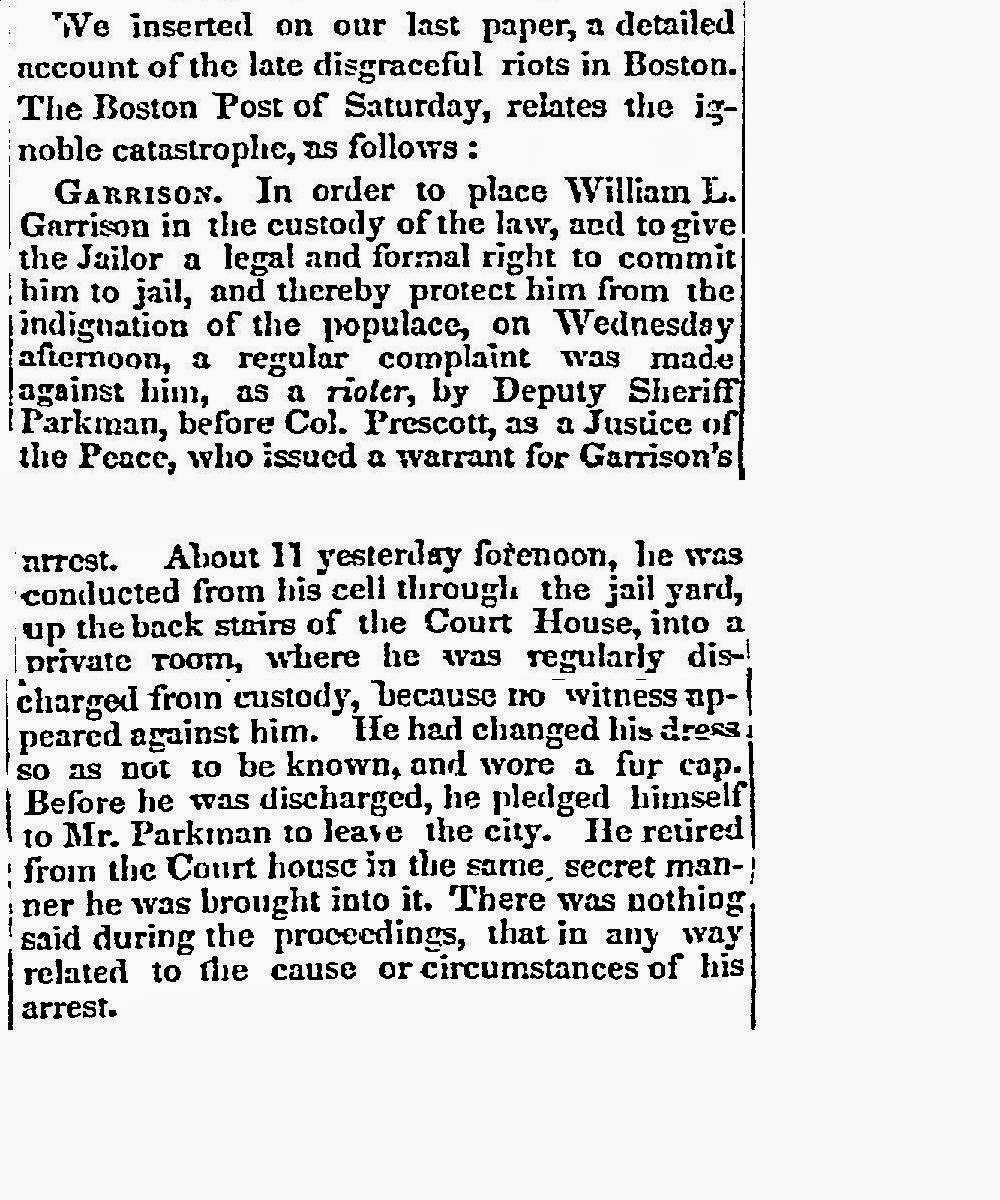
The story then becomes one of a remarkably dignified walk by the women, black and white, arm in arm, six blocks down Washington Street, through an angry mob, still resolute in determination to continue their meeting. It is also the story of a portion of the mob gaining access to the building, grabbing Garrison, and his final release from the crowd by “two burly Irishmen not know as abolitionists”. He was then rushed by constables, into a carriage, and taken to the Leveret Street jail for safety overnight. John Vashon visited Garrison the next morning, where he was in prison, and gave him a hat to replace the one which had been “cut in pieces by the knives of men of propoerty and standing”.

History most often gives emphasis to the threat to Garrison, who was indeed nearly lynched, and could have been killed by some in the mob. Here I want to lift up the courage of the women who walked through that mob, undeterred in the immediate purpose of their meeting, or the overarching purpose of abolition. Here also it is appropriate to some who were present that day who were led to become dedicated abolitionists.

Young Wendell Phillips, son of Boston‘s first Mayor, dated his “conversion” to the abolitionist cause from the day when he witnessed the mob. Henry Ingersoll Bowditch, just returned from medical training in Europe, knowing nothing of Garrison, was also infuriated by the mob’s action against Garrison. He vowed himself an abolitioinst from that moment, and shortly after subscribed to Garrison’s Liberator.


Edmund Quincy, son of the second Mayor, was alerted toward the rights of abolition. His father, Josiah Quincy, then President of the City Council, saw the mob from his office at 27 State Street, rushed to Garrison’s side until he was placed in the carriage and driven off, . Rev. James E. Crawford, later of Nantucket, was walking on State Street and encountered the riotous mob, and “his heart and soul became fully dedicated to the cause of immediate emancipation. Thirty years later, William H. Logan told of how, soon after the mob had left, he had received from Sheriff Parkman, remnants of a pair of pantaloons which had been torn from Garrison. At that same 1855 remembrance of the occasion, William C. Nell reported that a Boston merchant, David Tilden, Esq., “immediately became a subscriber to the Liberator and continued a reader until his death. Reports of several others of the affect of being witness may be suspect, but the affect on Harriett Martineau was widely reported. Martineau, an English teacher, professor, liberator, had been in the country for months, conducting what might be termed a sociological study of slavery. She had interviewed slave owners and abolitionists alike, adhering to her academic style for the most part. On the historic day, she was on her way from Salem to Providence, passing through Boston as the crowd was gathering. Friends, seeing the well-dressed crowd, and knowing it was close to a Post Office, informed her that the crowd was assembled because it was a “busy foreign-post day”. In Providence she heard the factual account. She volunteered her interest and within a few weeks she was a speaker at the Society. In December she visited Garrison in Boston, and became a worthy supporter.


This date, October 21, 1835 is worthy of celebration as a “moment” of gathering strength for the Abolition Movement in the United States. Five years later, in London, came a similarly significant “moment” of strength for abolitionists in the United Kingdom. In that “moment”, a major issue revolved around what some have called the “woman” question.

Public Sentiment at the North Date: Saturday, March 7, 1835  Liberator (Boston, MA) 


 [Boston; Post; Saturday; Garrison; William L. Garrison; Jailor; Wednesday; Deputy; Sheriff; Parkman] Tuesday, October 27, 1835  Salem Gazette (Salem, MA)


Other Reads

Sunday, July 6, 2014

Anson Green Phelps & The Phelps Dodge Dynasty

From the Archives For my Phelps Group Connection to join Phelps Genealogy in America
Ad 1887 Guide to the Phelps Dodge Co


Phelps Dodge Co
A History of Phelps Dodge, 1834-1950
Junior engineer to president, director of Phelps Dodge, 1937 to 1983 : oral history transcript / 1996

19th-Century Origins

In 1834 founder Anson Phelps, a New York entrepreneur thoroughly experienced in the import-export trade and well-connected in his targeted British market, formed Phelps, Dodge & Co. Along with his junior partners, sons-in-law William Dodge and Daniel James, Phelps supplied his English customers with cotton, replacing it on the homeward jou rney with tin, tin plate, iron, and copper, for sale to government, trade, and individual consumers in the United States. Before long, Phe lps started a manufacturing company in Connecticut called the Ansonia Brass and Battery Company, and in 1845 he helped organize the Ansonia Manufacturing Company, which produced kettles, lamps, rivets, buttons, and other metal items.
Phelps steered his fledgling empire grimly through a seven-year panic that began during 1837. His reward came during the following 14 year s of national prosperity, when large numbers of his products went west with new settlers, accompanied travelers on the rapidly expanding railroads, and provided a modicum of comfort for miners at the recentl y discovered Sierra Nevada gold deposits in California. Even broader markets came from such inventions as the McCormick reaper and the electric telegraph, whose need for cable wire would swell Phelps Dodge c offers well into the next century. By 1849 the company was capitalized at almost $1 million, and its profits were almost 30 percent.
Phelps's death in 1853 gave his son and each of his two sons-in-law a 25 percent interest in the business, with 15 percent going to a younger son-in-law. This second partnership was scarcely five years old when Anson Phelps, Jr., died. On January 1, 1859, the partnership was revised again, to increase the firm's capitalization to $1.5 mill ion and to give William Dodge and Daniel James each a 28 percent share. With reorganization complete, the company turned its attention to developing industries such as mining.
An interest in timber had begun in the mid-1830s, when Phelps, Dodge accepted timber-lands in Pennsylvania in lieu of payment for a debt. Later it built the world's largest lumber mill there, establishing a timber agency in Baltimore, Maryland, to send its products to domestic and foreign customers.
Despite these diversification, the principal interests of the company were still mercantile. However, through the advice of James Douglas , a mining engineer and chemical geologist, Phelps, Dodge was persuaded to take a large block of stock in the Morenci copper mine in what was then the Arizona Territory. Morenci was owned by the Detroit Copper Company, which exchanged the stock for a $30,000 loan. Douglas was also enthusiastic about prospects for another claim called Atlanta, situated in Arizona's Bisbee district, about 200 miles southwest of Morenci. In 1881 the company bought the Atlanta claim for $40, 000.
Two years later Phelps, Dodge had a chance to purchase the adjoining Copper Queen mine, which was then producing about 300 tons of ore monthly. The partnership decided to buy Copper Queen when Douglas hit th e main Atlanta lode in 1884, at almost the same time that a Copper Queen tunnel penetrated the lode from a different spot. Arizona mining operations at the time stuck strictly to the "rule of the apex," according to which a claim owner could follow a vein of ore onto another claim, if the deposit had come closest to the surface on his land. Th is had occurred with Copper Queen, and Phelps, Dodge, rather than ris k losing this strike to the Copper Queen owners, purchased the Copper Queen mine, merging it with the Atlanta claim.
In August 1885 Phelps, Dodge & Co. decided to streamline its operations by incorporating the subsidiary Copper Queen Consolidated Mining Company in New York, with James Douglas as president. Cautiously, Douglas made no major acquisitions for ten years. Then, he bought the Moctezuma Copper Company in Sonora, Mexico, from the Guggenheim family. Two years later he purchased the Detroit Copper Company.

James S Douglas Mine Tales (1867–1949) Antique Ansonia Clocks was the first company owned by Anson Green Phelps


Rev Anson Green Phelps Dodge JR B: June 30, 1860 N Y City, NY D: 1898 St. Simon's Island, Georgia Father: Anson Green Phelps Dodge SR (1834-c. 1899) Mother: Rebecca Wainwright Grew (1836-1925) Married: (1) Ellen Ada Phelps Dodge Eloped June 5, 1880, London, England Married: (2) Anna Deborah Gould (1856-1927) 1890 St. Simon's Island, Georgia. Children: by Ellen Ada Phelps Dodge: none by Anna Deborah Gould: Anson Green Phelps Dodge, 3rd (1891-1894)


Ellen was the daughter of Rev. D. Stewart Dodge, of New York State, a Presbyterian clergyman, and his wife Rachael. Ellen married her cousin, Rev. Anson Green Phelps Dodge, and although she died in India fifteen years before he did, she is buried with him on St. Simons Island. Find A Grave
Born: Feb. 28, 1862 New York, USA Death: Nov. 29, 1883 Allahabad, India
An excerpt from the long obituary of her husband, which appeared in the ATLANTA CONSTITUTION, August 28, 1898, on page 4:
"When his first wife died in India, Mr. Dodge had her body embalmed by one of the most noted embalmers in that country. It was inclosed in a metallic coffin and then placed in an ebony casket. This was carried across two continents to its last resting place on St. Simons. At Frederica the memorial church stands, one of the most expensive of the smaller churches in this section. On the wall to the right of the altar this inscription is engraved on a marble tablet:
To the glory of God and in loving memory of Ellen Ada Phelps Dodge, beloved wife of Rev. A. G. P. Dodge, Jr. Born February 28th, 1862; died November 29, 1883, at Allahabad, India. To her under God is due the rebuilding and endowing of this church. May she rest in peace."

Rev. Dodge wrote directions that his former wife's remains were to be taken from their ebony casket and placed in a pine coffin like his own, and the two were then to be placed side by side in the burying grounds at Frederica. Their grave was dug "under the shadow of Wesley Oak, where John Wesley first expounded Methodism in this country..."


Anna was the daughter of Horace B. Gould and Deborah Abbott, both of Glynn Co., Georgia. She married Rev. Anson Greene Phelps Dodge, Jr. as his second wife.Birth: Dec., 1856 Glynn County Georgia, USA Death:  Mar. 18, 1927 Saint Simons Island Glynn County Georgia, USA


See The Phelps Papers: The papers consist of diaries kept by Anson Greene Phelps, philanthropist, officer in several voluntary associations, manufacturer, and founder of Ansonia, Connecticut. The diaries cover the years 1806-1807 and 1816-1853 and primarily contain thoughts on religious subjects.

Anson Green Phelps I (1781-1853) Father Thomas Phelps (1741 - 1789) Mother Dorothy Lamb Woodbridge Phelps (1745 - 1792)
Of an old Connecticut family. Orphaned at age ten, Anson Green Phelps I (1781-1853) was apprenticed to a saddle maker and later set himself up in business in Hartford as a merchant. He traded saddles against cotton from Charleston SC which in turn he sold in New York and bought there the dry goods he marketed in his store. After the war of 1812, Anson Phelps moved to New York, where he associated himself to fellow Connecticut trader Elisha Peck, to form Phelps & Peck. The firm prospered and became New York's largest metal importer, with Phelps selling the metals in New York and buying cotton in the South which he exported to England. Peck handled the English end of the business in Liverpool. After the collapse of their new six story store at Cliff Street, the partnership was dissolved and Phelps took two of his sons-in-laws as partners to for Phelps, Dodge & Co in New York and Phelps, James & Co in Liverpool. Starting in 1834, Anson Greene Phelps involved himself in the brass industry which emerged in the Naugatuck valley in Connecticut. By the time of his death, some twenty years later, Phelps was one of the main factors in the copper and brass business, at the same time as Phelps Dodge & Co was the dominant metal importer. Ansonia, the industrial township he founded, stands as a monument to Phelps' enterprising spirit. Like other merchant capitalists, Anson Phelps had many other interests, including railroads, notably the New York & Erie, and banking. He owned a controlling interest in the Bank of Dover New Jersey, which was managed by his friend Thomas B. Segur. When he died in 1853, he left an estate exceeding $2 million, of which half was real estate in New York City and Ansonia. From his marriage to Olivia Eggleston, he had six daughters and one son Anson Phelps jr., who married but had no children. Three of his sons-in-law (William Earl Dodge, Daniel James and James Stokes) joined Phelps Dodge & Co and fathered one of New York's most renowned merchant dynasty.


The family to which Mr. Dodge belonged is descended from William Dodge, son of John Dodge of Somersetshire, England, who was one of the settlers of Charlestown, Mass., in 1629. A branch of this family settled in Connecticut about the time of the Revolution from which came David Low Dodge, grandfather of Wm. E. Dodge, jr., who married Sarah, daughter of the Rev. Aaron Cleveland, grandfather of ex-President Cleveland R Dodge's mother was Melissa Phelps, daughter of Anson Green Phelps, founder of the firm of Phelps, Dodge & Co., and Oliver Egleston, daughter of Elihu and Elizabeth (Olcott) Egleston. She was descended from George Phelps who came over in the Mary and John and first settled in Dorchester, and numbered among her ancestors, Governors Dudley, Haynes and Wyllys.
Read Letter 1839 Melissa Phelps Dodge 


Mr. William Earle Dodge received his education in New York City and followed the path his father trod before him both in business and ublic life. In 1864 he became a partner in the firm of Phelps, Dodge & Co., an finally senior member of the firm. His connection with this house, however, constituted only one of the various interests of his business life. The town of Ansonia, Conn., had been named after his grandfather, Anson G. Phelps, and its industries were fostered by the two families united in the Phelps-Dodge marriage. He became president of the Ansouia Clock Company, and a director in the Ansonia Brass Company. He was also a director in many railway and mining comanies, a trustee of the New York Life Insurance Com any, and the Atlantic utual Insurance Company, and was vice-president o the New York Chamber of Commerce at the time of his death.

Yet varied as were his business interests these constituted only a fraction of the many interests with which Mr. Dodge identified himself. He was one of the most patriotic, public spirited and philanthropic citizens of New York, and perhaps the most active of them all in things which concerned its best welfare.

While still a young man he began to take a deep interest in all matters affecting the public welfare and he gave his hearty support to almost every reform or public work of importance. During the civil war he was active in many ways; was one of the founders of the Union League Club, and a projector of the Sanitar Fair; served in the Allotment and Sanitary Commissions, and was one of the commissioners of the State of New York to supervise the condition of its troops in the field. His commission was one of the first signed b President Lincoln, and at the conclusion of his service he received a vote 0 thanks from the Legislature of the State for his efficiency. "At the time of the draft riots in New York City, he was the man who found the ammunition which the militia used to tell the mob. The city was in a turmoil, and the militia was under arms in t e armories, but not a cartridge could be found for the soldiers. The State and federal authorities were appealed to without success, and the city was looking forward to another night of terror, when it occurred to Mr. Dodge to go to the navy yard and secure ammunition from the commandant there. The commandant was willing to give the cartridges, but could furnish no men to take them to the armories, as he was having trouble defending the yard. At last Mr. Dodge got a truck, loaded the ammunition on it, and himself drove it through the,streets to one of the armories. The militia was armed and the city was quieted."—N. 1’. Tribune.

Mr. Dodge was much interested in various public institutions and societies founded to promote the knowledge of science and art among the people. He was vice-president, trustee and chairman of the Executive Committee of the Metropolitan Museum of Art, and was very active in its behalf; was also vice president and trustee of the American Museum of Natural History, and a trustee of the New York Botanical Garden; was a trustee of the Carnegie Institution, and a member of the New York Academy of Science, the Linnehan Society of New York, the American Geographical Society, the American Historical Association,and of the New York Historical Society . But he specially interested himself in the welfare of the young men 0 New York Cit , devoting himself to the work of the Young Men's Christian Association, with which he was connected from the be inning of its prosperity, serving it for many years as president of its Board 0 Trustees. It was largely through his activity that its first building in Twenty-third Street was erected, and he lived to carry through the project of a new building for the Association now almost completed. He was also president of The Evangelical Alliance, and of the National Temperance Society; was vice-president of the American Sunday School Union, and chairman of the National Arbitration Committee. He contributed liberally of his means as well as his services to the institutions and objects with which he was identified, and it was often said no good cause ever appealed to his generosity in vain. He presented to the garrison at Governor's Island a fine Young Men's Christian Association building, which was opened in July, 1900. He led a fund to endow Union Theoloical Seminary as well as gave valuable moral support to that institution. e founded a lectureship on " The Duties of Christian Citizenship" at Yale; gave largely to the Woman's Hospital, and as chairman of the Abram S. Hewitt Memorial Fund collected over two hundred thousand dollars, to which amount he was one of the largest contributors. His last beneficence was the gift to Columbia University, in 1902, of Earl Hall, as the club center of the university.

William E. Dodge married Sarah Tappan Hoadley, daughter of the late David Hoadley, president of the Panama Railroad, who survives him. He leaves also one son, Cleveland Hoadley Dodge, member of the firm of Phelps, Dodge & Co., and three daughters; Grace Hoadley Dodge, who has distinguished herself by her charitable work, especially amon working girls, and was the first woman to be appointed a member of the New York Board of Education; Mrs. William C. Osborn of New York, and May M. Dodge of London, England.


Anson Phelps Stokes (detail of a painting by Cecilia Beaux, Metropolitan Museum) Helen Louisa Phelps and Anson Phelps Stokes at the time of their engagement

Clockwise from center: Helen Phelps Stokes, J. Graham, Isaac Newton, Helen O., Sarah M., 1872. Stokes Records, vol I, after p. 182 

Dodge Burial: Bronx Bronx County New York, USA
Plot: Ravine, section 33, catacomb 2 Woodlawn Cemetery


Golden Wedding; Dodge Wednesday, June 26, 1878 Springfield Republican MA 


Phelps Dodge Mercantile Co. Dawson, NM


Popular Post