A Share from
Mathew Crowther, aka "Shortshanks" from his blog
And check out his newest
The Print Shop
Melissa Berry came across Mathew's blog researching
Edmund March Blunt for her column
But also in a column on
"Lord" Timothy Dexter of Newburyport
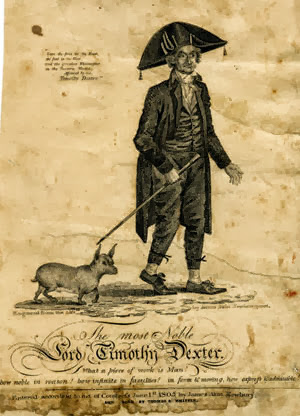 |
| by James Akin |
The two-part biography of the Anglo-American caricaturist William
Charles that appeared on The Print Shop Window a couple of weeks ago
focused upon the subject of American political caricature during the War
of 1812. In this post we’ll look at a print by another American
caricaturist that touches upon the subject of that war but it is an
image which is far less well-known and one whose history is somewhat
incomplete.
A Bug-a-boo to Frighten John Bull, or the Wright Mode for Kicking Up
was produced by James Akin, an American printmaker whose talent as a
satirist arguably exceeded those of the more famous Charles but who has
remained something of an obscurity because of a sympathy with the
Federalist cause that perhaps put him at odds with subsequent
generations of patriotic American historians. This is a shame because
Akin was clearly both a clever and creative satirist and a technically
skilled draughtsman, with a style that is reminiscent of the prolific
British caricaturist Charles Williams. Indeed, Akin's talents were such
that it is possible that he was the only American caricaturist who was
capable of selling prints and designs in England during the early
Nineteenth Century [1].

Apparently an American print. In the foreground is an American merchantman, the poop towards the spectator and crowded with men of un-nautical appearance; she is inscribed 'Wright of Maryland'. A few yards off is a naval ship's boat inscribed 'Revenge' in which a British officer, wearing a large cocked hat, stands, cutlass in hand, holding the tiller. There are six oarsmen. A man on the American vessel tipsily fires a pistol at the boat; the officer shouts: "I'll have you tuck'd up at the yard Arm, you rascal for daring to fire upon His Majestys barge." The man answers: "Damn you Majesty & your furbillo'd hat." One of the sailors, apparently hit, hangs lifeless over the edge of the boat. One American seaman swims towards the British boat, saying, "60$ a month is worth a wet Jacket any time"; a sailor prepares to help him in, saying, "Give us your fist my brave fellow you were rather too nimble for us". Two of the other British sailors say: "Dont be firing here & be D------d to you" and "I wish we had a Congress to Hansel us ye Dollars". An American seaman is about to drop overboard; he says to the British sailors: "Bear a hand shipmates or I'll be swamp'd too." Behind him are a Negro and an Irishman; the former says: "Ki massa I grad fo go long you my nooung massa been read say inney paper massa Wright gwine gie me 200 Dollah." The Irishman says: "Bie my sowl I'll go wid ye for 60 dollarhs a munt." One seaman seizes another, saying, "you shant go Nat sister Nabby will cry dreadfully if you be not to home." The man pushes him off, saying, "Leave me be Ned our marchents wunt give me 60$ wages." A third (with deformed hands) brandishes a saucepan, saying, "Rascals", while a fourth says to him: "I say Old crooked knuckles why heave the skillet overboard?" On the extreme right the master of the vessel looks towards the British boat, saying, "You'd best make no difficulty with my people, for there's a bill before Congress, to shoot every Englishman at 200$ pr head." The sails form a background to the men. In the middle distance is a British man-of-war to which the barge belongs. Behind is a harbour with vessels at anchor, backed by the houses of a small port; behind are cliffs surmounted by a castle flying a British flag. c.1806
In addition the following note has been added to the online catalogue;
The date being uncertain the situation is obscure. 'Wright' is probably Robert Wright (1752-1826), senator, and Governor of Maryland, a strong Jeffersonian, who introduced a Bill in 1806 for the protection and indemnification of American seamen, and supported measures for the protection of American commerce and the prosecution of the War of 1812 with Great Britain. Desertion for higher pay was in general from British to American ships. The tension between the two countries was great and increased until the outbreak of war.
This description is partially correct but it’s possible, with a little research, to come up with a much more comprehensive explanation of the meaning of this print.
The print refers to the dispute which arose between Britain and the United States over the British practice of press-ganging sailors from aboard American vessels during the Napoleonic Wars. Although the British claimed that they were only ever seeking to recover British sailors who were lawfully obliged to serve in the Royal Navy during wartime, in practice the policy of impressment inevitably led to many hundreds of American sailors being wrongfully seized and forcibly conscripted into the British fleet. The whole issue was made even more complex by the fact that the American merchant fleet had become a haven for those who had deserted the Royal Navy and that American consular officials and merchant captains often connived to provide British runaways with papers of American citizenship. Eventually the issue was to become one of the main casus belli underpinning the United States deceleration of war against Great Britain in June 1812.
In 1806 a hawkish Republican senator named Robert Wright came up with his own radical solution to the problem of impressment. Wright brought a bill ‘for the protection and indemnification of American seamen' before Congress in January of that year which aimed at encouraging American sailors to use force in order to repel British boarding parties who were attempting to stop and search US ships. The bill contained clauses which would have granted legal immunity and a $200 bounty to captain's who repelled British boarding parties attempting to search American vessels and promised that any American sailor who was wrongfully pressed into British service would receive $60 a month in compensation from the US government.
Akin's print reflects the view of Federalist opponents of the bill, who argued that large compensation payments and bounties would simply reverse the flow of deserters moving between the British and American fleets and encourage American captain's to engage in provocative behaviour that would end in all-out war with Great Britain. That is why the print depicts a rather preposterous scene in which the ragtag crew of the Wright of Maryland seem torn between the suicidal desire to engage a heavily armed British frigate in combat and to leap overboard be pressed into the Royal Navy and claim their $60 a month compensation.
The presence of the skillet-wielding figure on the poop-deck of the American vessel can also be used to date the publication of this print to 1806 as this character appears in a number of prints Akin produced in that year.
 |
| James Akin, Infuriated Despondency!, c.1805 |
It's possible that A Bug-a-boo to Frighten John Bull... was one
of the last caricature prints Akin produced before he left Newburyport
in October 1807 and returned to his native Philadelphia. He certainly is
not known to have produced any more caricatures featuring Blunt after
this period and by 1808 he appears to have begun another equally caustic
feud with a Philadelphia bookseller called Richard Folwell, who
replaced Blunt at the chief target of Akin's satirical invective. This
therefore gives us a further indication that the print was almost
certainly produced in 1806.
James Akin appears to have abandoned caricature and printmaking
altogether between 1811 and 1819 and he disappears entirely from the
Philadelphia trade directory during this period. This is a shame because
one can imagine that the combination of his acidic wit and ardent
Federalism could have resulted in him producing some fascinatingly
unconventional satires during the War of 1812.
[1]. A Bug-a-boo to Frighten John Bull... was one of the few
American prints from this period to be found amongst the collection
Edward Hawkins (1780 - 1868) in London and it is also claimed that
Akin's Infuriated Despondency! was transfer printed onto Liverpool
creamware in England. See F.B. Sanborn, 'Thomas Leavitt and his Artist
Friend, James Akin' Granite Monthly 25, No. 10, pp. 226 - 227.


